
TL;DR:
- Real-time data logging is essential for operational survival and is no longer a competitive advantage.
- It enables faster decision-making, reduces downtime, and supports cost savings across various industries.
- Successful implementation involves phased deployment, overcoming legacy system challenges, and continuous data-driven tuning.
Real-time data logging is no longer a competitive differentiator — it is quickly becoming a baseline requirement for operational survival in critical infrastructure. Columbia Pipeline achieved 99.5% reliability and $2.3M in savings through real-time data logging, which signals just how significant this technology has become. For operations managers and decision-makers, the question is no longer whether to adopt real-time IIoT data logging, but how to do it efficiently and at scale. This article presents the evidence, practical frameworks, common pitfalls, and actionable steps you need to move forward with confidence.
Table of Contents
- What is real-time data logging and why does it matter?
- Core benefits: From efficiency gains to cost savings
- How real-time data logging enables predictive maintenance and resource optimization
- Practical challenges and how to overcome them
- A perspective: Why slow, cautious IIoT adoption is often more costly than you think
- See real-time data logging in action with industry solutions
- Frequently asked questions
Key Takeaways
| Point | Details |
|---|---|
| Proven efficiency gains | Real-time data logging directly increases operational reliability and reduces costs for critical infrastructure. |
| Predictive maintenance enabler | Continuous, real-time logging is essential for early failure detection and resource optimization. |
| ROI through actionable insights | Benchmark studies show immediate and ongoing returns by turning raw data into decisive action. |
| Adoption challenges are solvable | With phased rollouts and stakeholder engagement, technical and cultural obstacles can be minimized. |
| Delay has hidden costs | Waiting to implement real-time data solutions can be more costly than starting with small, measurable steps. |
What is real-time data logging and why does it matter?
Real-time data logging, in the IIoT context, is the continuous, automated collection and transmission of sensor data from physical assets to a central platform, where it can be monitored, analyzed, and acted upon with minimal delay. Unlike batch logging, which stores data locally and transmits it at scheduled intervals, real-time logging gives operators immediate visibility into what is happening across their infrastructure. That distinction is not trivial. When a pressure valve starts behaving abnormally in a pipeline, seconds matter.
The contrast between real-time and batch logging becomes stark during incidents. Batch systems may only surface a developing fault hours after it began, leaving operators scrambling to respond after damage is done. Real-time systems flag anomalies the moment they appear. That immediacy drives three major operational outcomes:
- Faster decision-making: Operators act on live data rather than historical summaries, reducing response lag significantly.
- Reduced unplanned downtime: Early alerts allow maintenance teams to intervene before a minor issue becomes a costly failure.
- Accurate compliance reporting: Continuous data streams create reliable audit trails for regulatory and ESG reporting obligations.
A common misconception is that real-time data logging is only viable for large-scale enterprises with deep capital budgets. In practice, modern IIoT platforms scale from single-site deployments to enterprise-wide networks. Small water utilities, mid-sized retail chains, and agricultural operations are all implementing real-time logging solutions at manageable costs.
“The business case for real-time monitoring is not theoretical. Decision-makers see clear ROI from reduced downtime and costs in benchmarks across multiple industries.”
For IIoT-driven operations, the value of real-time energy monitoring benefits extends beyond simple cost tracking. When you connect sensor data to actionable workflows, every layer of your infrastructure becomes more responsive, efficient, and measurable. The fundamentals of real-time data logging are well established. What differs across organizations is how effectively that data is translated into operational action.
Core benefits: From efficiency gains to cost savings
With an understanding of what real-time data logging is, let’s evaluate the measurable value it delivers. The numbers from real-world deployments are striking and worth examining closely.
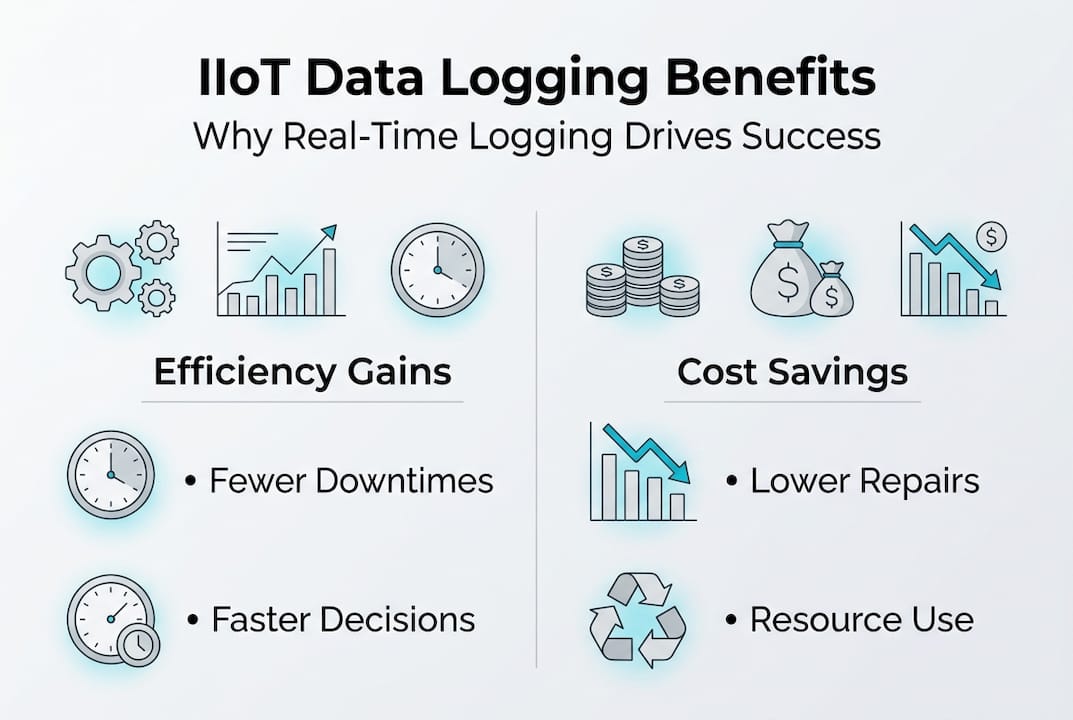
Headline results from major case studies:
| Organization | Outcome | Value |
|---|---|---|
| Columbia Pipeline Group | System reliability improvement | 99.5% uptime |
| Columbia Pipeline Group | Annual cost savings | $2.3 million |
| Vattenfall | Annual savings via valve diagnostics | €200,000 |
| CenterPoint Energy | Capital expenditure reduction | 80% |
Vattenfall’s results are particularly instructive. The company saved €200,000 per year through valve diagnostics enabled by continuous real-time data streams. That is not a one-time saving; it compounds annually. For any operations manager evaluating the business case for IIoT data logging, that single data point reframes the entire conversation.
The three-step impact pathway from data to value:
- Data collection: Sensors capture continuous readings from assets, whether energy meters, flow sensors, pressure gauges, or environmental monitors.
- Insight generation: The cloud platform processes incoming data streams, applying thresholds, trend analysis, and anomaly detection to surface actionable intelligence.
- Operational action: Alerts trigger maintenance requests, automated shutoffs, or resource reallocation, transforming raw data into measurable outcomes.
This pathway applies equally to energy consumption optimization in retail environments as it does to pipeline management. The underlying mechanics are the same; the use cases differ by industry context.
Key stat: Organizations that implement real-time data logging report reliability rates approaching 99.5%, with capital cost reductions of up to 80% in some infrastructure programs.
Beyond the headline numbers, real-time data logging also delivers competitive advantage. Organizations that can demonstrate precise resource management, emissions tracking, and operational transparency are better positioned for regulatory compliance and ESG reporting. For decision-makers, that means data logging is not just an operational tool; it is a strategic asset. Reviewing real-world industry case studies reveals just how consistently these benefits materialize across sectors.
How real-time data logging enables predictive maintenance and resource optimization
Value is maximized when data logging goes beyond dashboards into actionable outcomes like predictive maintenance. Predictive maintenance uses continuous sensor data to detect early warning signs of equipment degradation, allowing teams to schedule interventions before failures occur. It is fundamentally different from scheduled maintenance, which operates on fixed time intervals regardless of actual asset condition.
Scheduled vs. predictive maintenance: A comparison
| Dimension | Scheduled maintenance | Predictive maintenance |
|---|---|---|
| Trigger | Fixed time interval | Real-time sensor anomaly |
| Cost efficiency | Moderate (often over-maintains) | High (targeted interventions) |
| Downtime risk | Moderate (failures still occur) | Low (early detection) |
| Data dependency | Low | High (requires real-time logging) |
| ROI timeline | Slow | Faster, measurable per use case |
CenterPoint Energy’s experience illustrates this clearly. By adopting real-time monitoring, the company achieved an 80% capital expenditure reduction, a result that stems directly from replacing unnecessary scheduled work with targeted, data-driven interventions.

Real-time alerts are the practical engine behind predictive maintenance. When a sensor reading crosses a defined threshold, your team receives an immediate notification, whether that is a flow rate anomaly in a water distribution network or a temperature spike in an energy asset. You intervene early, spend less, and keep systems running.
Industry scenarios where this compounds in value:
- Pipeline operations: Continuous pressure monitoring flags micro-leaks before they become ruptures, avoiding both safety incidents and regulatory penalties.
- Water utilities: Flow and level sensors detect distribution losses in real time, supporting water utility case studies that show measurable reductions in non-revenue water.
- Manufacturing energy management: Real-time logging identifies inefficient load patterns, as demonstrated in a manufacturing energy management example where actionable data reduced consumption significantly.
Pro Tip: Start your predictive maintenance program with one high-value asset class. Prove the ROI in that narrow context before scaling. This focused approach builds internal confidence and delivers early wins that justify broader investment.
Practical challenges and how to overcome them
Achieving these outcomes comes with hurdles that can be addressed when anticipated. Understanding common failure points before you begin allows your team to plan around them rather than react to them mid-deployment.
Common implementation challenges:
- Legacy system integration: Older infrastructure often lacks native data output capabilities, requiring protocol converters or edge gateways to connect sensors to modern IIoT platforms.
- Data overload: High-frequency sensor streams can generate enormous data volumes. Without proper filtering and alerting logic, operations teams can lose signal in the noise.
- Team resistance: Frontline operators sometimes view data logging as surveillance rather than support, which can undermine adoption and data quality.
- Connectivity gaps: Remote infrastructure, such as pipelines or agricultural sites, may lack reliable network coverage for continuous data transmission.
A four-step approach for successful rollout:
- Audit your assets and connectivity: Map which assets need monitoring, what data they should produce, and what connectivity technologies, such as LoRa, NB-IoT, or LTE-M, are appropriate for each location.
- Define clear use cases and success metrics: Choose two or three high-impact scenarios and define what success looks like in measurable terms before deployment begins.
- Engage operators as stakeholders: Involve frontline staff early. When operators understand how real-time alerts reduce their reactive workload, resistance often turns into advocacy.
- Iterate after initial deployment: The first version of your alerting logic will not be perfect. Plan for a tuning period of 60 to 90 days to refine thresholds and workflows based on live data.
Pro Tip: Frame data logging for your operations team as a tool that reduces emergency callouts and reactive stress, not as a monitoring system. That framing shift changes the adoption conversation entirely.
“Success comes from phased rollout and value verification per use case. Predictive maintenance is a strong first candidate because its ROI is direct and measurable.”
Ongoing tuning is where many deployments underperform. Organizations that treat go-live as the finish line miss the compounding returns available through continuous refinement. For teams working through rollout complexity, reviewing residential real-time data examples can offer useful scale-up insights that apply to larger infrastructure contexts as well.
A perspective: Why slow, cautious IIoT adoption is often more costly than you think
The conventional view is that deliberate, gradual IIoT adoption is the responsible choice. We would argue that perspective misses the true cost of waiting. Every quarter you operate without real-time data is a quarter of undetected inefficiencies, missed maintenance windows, and decisions made on incomplete information. Those costs are real; they just do not appear as a line item on the budget.
Fast adopters, as evidenced in the case studies reviewed here, do not win because they took bigger risks. They win because they started gathering data earlier, which means they accumulated more operational intelligence sooner. The gap between fast movers and laggards is not just financial; it is informational. And informational advantages compound.
The myth that gradual adoption is always safer deserves scrutiny. In FMCG industry lessons and beyond, we see that delayed deployment often means delayed savings, delayed compliance readiness, and delayed competitive positioning. The risk calculus looks very different when you account for what you are losing each month you wait, not just what you are spending to move forward.
See real-time data logging in action with industry solutions
The evidence is clear: real-time data logging is a critical capability for any operation that depends on asset reliability, resource efficiency, and cost control. Whether you are managing pipelines, energy networks, water distribution, or manufacturing facilities, the path from data to savings is well documented and repeatable.

We build remote IoT monitoring solutions designed specifically for the complexity and scale of critical infrastructure. From configurable data loggers to a cloud analytics platform and mobile app, our turnkey approach means you can move from pilot to full deployment without disruption. If energy consumption is your priority, explore our smart energy consumption monitoring solution to see exactly how continuous data logging translates into measurable operational savings.
Frequently asked questions
What industries benefit most from real-time data logging?
Critical infrastructure industries like energy, water utilities, manufacturing, and pipelines gain the most from real-time data logging. As demonstrated by Columbia Pipeline, energy, and water utilities, the combination of reduced downtime and continuous operational insight delivers measurable, recurring value.
How does real-time data logging improve predictive maintenance?
It enables early identification of failures by providing continuous sensor data, which supports timely maintenance and minimizes unplanned outages. Real-time logging allows predictive maintenance to deliver direct, measurable ROI rather than the theoretical savings often associated with scheduled maintenance programs.
What are the key challenges in implementing real-time data logging?
Main challenges include integrating legacy systems, managing large data volumes, and ensuring staff buy-in across operations teams. Phased rollout and proving value on a case-by-case basis are the most reliable strategies for overcoming each of these barriers.
Does real-time data logging require major infrastructure investment?
Not always. Modern IIoT solutions support scalable deployments that start small, prove value, and expand incrementally, which means you can control upfront costs while still capturing meaningful operational benefits from day one.


