KYZ is the pulse output you meet on electricity meters in North America, and on many gas and water meters built to the same convention. It uses three wires instead of two, and that small difference changes how the pulses are counted. This guide explains what a KYZ pulse is, where you find it and how to turn it into consumption data.
KYZ in short
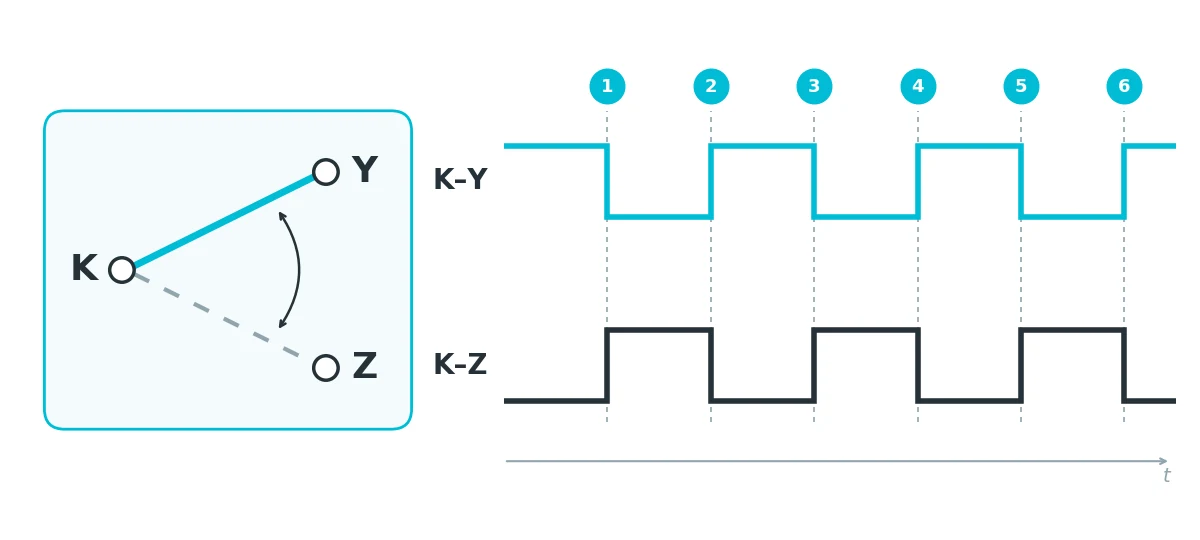
- K, Y and Z are the three terminals of one single-pole double-throw (SPDT) contact, also called a Form C or changeover contact
- K is the common terminal; the contact connects K to Y or K to Z, never to both
- Every change of state, from Y to Z or back, is one pulse
- Each pulse stands for a fixed quantity, for example 0.1 kWh, set by the pulse constant of the meter
How a KYZ pulse works
Inside the meter a relay or a solid-state switch flips between two positions. In one position K is connected to Y, in the other K is connected to Z. Each time a fixed amount of energy, gas or water has passed, the switch flips once. The receiving device watches both circuits and counts every flip.
Watching two circuits is what makes KYZ robust. A valid pulse needs one circuit to open and the other to close, so contact bounce or noise on a single wire is not counted as consumption. This is the reason utilities use Form C for revenue-grade pulse outputs.
The output is a dry contact: the meter supplies no voltage. The device that reads the pulses provides a small sensing voltage on K and detects which of Y and Z is closed.
KYZ compared with other pulse outputs
| Output | Wires | What counts as one pulse | Typical devices |
|---|---|---|---|
| KYZ, Form C | 3 | Every changeover between Y and Z | Electricity meters in North America, sub-meters, some gas and water meters |
| KY, Form A | 2 | Every closure of one contact | Gas meters and volume correctors, water meter pulse registers |
| S0, open collector | 2, polarised | Every current pulse of at least 30 ms | European DIN-rail energy meters (EN 62053-31) |
| Reed switch | 2 | Every closure by the magnet on the dial | Mechanical water and gas meters |
Where you find KYZ pulses
- Utility electricity meters at commercial and industrial sites, where the utility provides a KYZ output on request, often through an isolation relay
- Electricity sub-meters and power monitors in buildings, campuses and tenant billing systems
- Gas meters and volume correctors with Form A or Form C pulse outputs
- Steam and thermal energy meters that report consumption as pulses
- Receivers: building and energy management systems, demand controllers and data loggers
From pulses to kWh and kW
Every KYZ output has a pulse constant, often written Ke: the quantity that one pulse represents. Consumption is the number of pulses multiplied by the pulse constant. Average demand is that consumption divided by the length of the interval.
Example
Pulse constant 0.1 kWh per pulse. In a 15-minute interval the logger counts 180 pulses.
Energy: 180 × 0.1 = 18 kWh
Average demand: 18 kWh ÷ 0.25 h = 72 kW
Ask the utility or check the meter documentation for the pulse constant, and whether it already includes the current and voltage transformer ratios. A wrong constant is the most common reason for readings that are off by a round factor.
Wiring a KYZ output
- Use all three wires when the receiver has a Form C input: K to common, Y and Z to the two pulse inputs
- Two wires also work: with only K and Y the receiver sees every second changeover, so the value of one pulse is doubled
- Do not apply external voltage unless the meter documentation asks for it: the receiver supplies the sensing voltage
- Agree the counting mode with whoever set up the meter, so that both sides count changeovers in the same way
KYZ is a pulse output. It is not the same as the 3-wire encoder output of US water meters, which sends the meter reading as data. That output has its own guide: 3-wire water meters explained.
Reading KYZ pulses with the ThingsLog LPMDL-210X
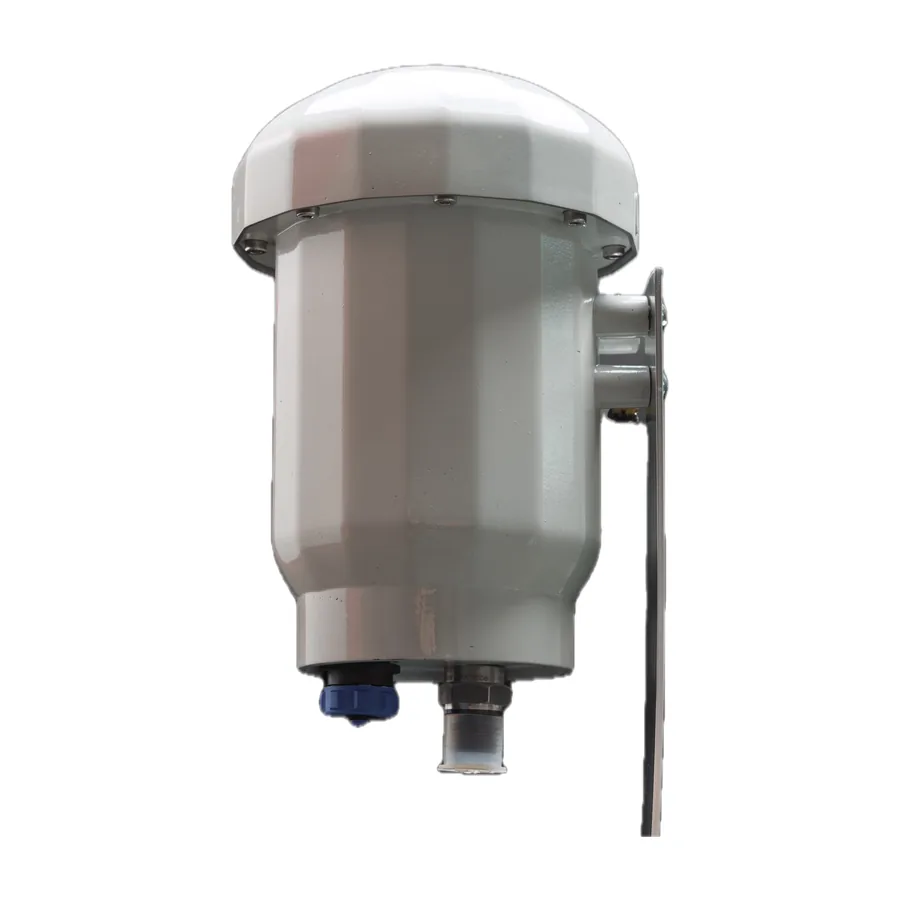
The ThingsLog LPMDL-210X data logger reads KYZ (Form C) pulses, next to reed switch and open collector pulses.
- A KYZ input uses two ports of the logger, so both circuits are watched
- IP68 enclosure and years on its own battery, with LTE-M, NB-IoT or 4G
- Consumption per interval and alarms in the ThingsLog platform and mobile app
Frequently asked questions
Is KYZ the same as Form C?
Yes. Form C is the name of the changeover contact, and K, Y and Z are the names of its three terminals. A two-wire output with a single normally open contact, K and Y only, is called Form A.
Can I read a KYZ output with a two-wire pulse input?
Yes, by connecting K and Y only. The input then counts one closure for every two changeovers, so the pulse constant has to be doubled. The protection against bounce and noise that the third wire gives is lost.
Where do I get the pulse constant?
From the utility for a revenue meter, or from the nameplate and the configuration of a sub-meter. Write it down together with the counting mode, because both are needed to turn pulses into energy.