
TL;DR:
- Industrial IoT data loggers enable significant cost savings and operational efficiencies across various sectors.
- They support real-time monitoring, automated alerts, and durable hardware for harsh environments.
- Successful deployment relies on clear purpose, staff training, phased implementation, and leveraging expert vendors.
Energy managers who deploy industrial IoT data loggers have reported $46,000 in annual energy savings plus $42,000 in utility rebates, while Vattenfall identified over €200,000 per year in previously invisible losses. These numbers tell a story that goes well beyond basic record-keeping. Data loggers have evolved into strategic operational tools that drive measurable cost reductions, regulatory compliance, and resource optimization across water utilities, energy, agriculture, and public sector organizations. This guide breaks down how they work, where they deliver the greatest value, and what it takes to deploy them successfully in complex industrial environments.
Table of Contents
- What are data loggers and how do they work?
- Core industry applications: Water, energy, agriculture, and beyond
- From manual to IoT: How data logging evolution changes operations
- Implementation challenges and best practices
- The practical truth: What we’ve learned deploying data loggers in the field
- Unlock greater efficiency with ThingsLog industrial solutions
- Frequently asked questions
Key Takeaways
| Point | Details |
|---|---|
| Real-time monitoring benefits | Data loggers provide continuous, actionable insights that help reduce costs and increase operational efficiency. |
| Diverse industry impact | From water utilities to energy and agriculture, data loggers support compliance, savings, and better decision-making. |
| Transition to IoT drives value | Moving from manual to connected IoT data loggers unlocks rapid alerts and more reliable data for critical response. |
| Challenges and solutions | Adoption hurdles like cost and complexity can be managed through phased implementation and expert partnerships. |
| Practical deployment wisdom | Field experience shows that clear goals and simple, scalable integration yield the best results with data loggers. |
What are data loggers and how do they work?
At their core, data loggers record sensor data over time and transmit it wirelessly to a cloud platform for real-time monitoring. They are not passive devices. Modern industrial loggers are active nodes in a data acquisition network, continuously capturing measurements from connected sensors and making that information available to operators anywhere, at any time.
The hardware chain is straightforward: sensors measure physical parameters, pass readings to the data logger, and the logger transmits those readings via wireless protocols such as GSM, Wi-Fi, or LoRa to a cloud platform. From there, dashboards, alerts, and analytics tools give your team actionable visibility. What makes this architecture powerful is its reliability. Industrial-grade loggers support battery life up to 12 years and are built to withstand harsh field conditions, from extreme temperatures to high-humidity enclosures.
Key hardware attributes to evaluate when selecting a data logger:
- Sensor compatibility: Support for analog, digital, and pulse inputs
- Connectivity options: LoRa, NB-IoT, LTE-M, Wi-Fi, and Ethernet for flexible deployment
- Power management: Ultra-low power consumption for long battery life in remote locations
- Enclosure rating: IP67 or higher for outdoor and industrial environments
- Data storage: Local buffering to prevent data loss during connectivity gaps
Pro Tip: Investing in loggers with proven durability ratings reduces replacement cycles and long-term maintenance costs significantly. Cheap hardware may save money upfront but creates reliability gaps that cost more to fix than prevent.
The table below shows typical parameters monitored across key industries:
| Industry | Parameters monitored | Primary purpose |
|---|---|---|
| Water utilities | pH, turbidity, TDS, DO, pressure | Compliance, leak detection |
| Energy | Voltage, current, power factor, kWh | Consumption optimization |
| Agriculture | Soil moisture, temperature, rainfall | Irrigation scheduling |
| Public sector | Air quality, noise, street lighting | Regulatory reporting |
For a deeper look at data logging basics and sensor selection, the range of industrial logger use cases across sectors continues to expand as connectivity costs fall.
Core industry applications: Water, energy, agriculture, and beyond
Now that we understand how data loggers function, let’s explore how they deliver results in key industries.
In water utilities, the impact is immediate and measurable. Data loggers monitor parameters including pH, turbidity, total dissolved solids (TDS), dissolved oxygen (DO), and temperature, supporting both regulatory compliance and active leak detection. Critically, NRW reduction of 15-30% is achievable when continuous pressure and flow monitoring replaces periodic manual checks. Non-revenue water (NRW) represents water that is produced but never billed, a significant financial drain for any utility. Reducing it by even 15% can translate to millions in recovered revenue annually for mid-sized operators.
In energy management, the financial case is equally strong. Real-time monitoring of consumption patterns enables facilities to identify waste, shift loads away from peak tariff windows, and qualify for utility rebates. Organizations focused on energy efficiency from real-time monitoring consistently report payback periods under two years. A single energy consumption optimization project at a retail facility, for example, can yield tens of thousands in annual savings once baseline data exposes inefficiencies.
The numbered list below captures the top measurable outcomes across sectors:
- Water utilities: 15-30% reduction in non-revenue water through continuous pressure monitoring
- Energy: Identification of >€200,000 per year in losses (as demonstrated in the Vattenfall case)
- Agriculture: IoT-based lysimeter data achieving R²=0.998 accuracy for evapotranspiration benchmarks, enabling precise irrigation
- Public sector: Automated compliance reporting, reducing manual site visits and associated labor costs
“The shift from periodic manual sampling to continuous IoT monitoring does not just improve data quality. It changes what decisions are possible.” This is the operational reality we see across IoT data logger applications in the field.
Compliance is another underappreciated driver. Regulators in water, air quality, and energy sectors increasingly require timestamped, auditable data records. Manual logs cannot meet this standard reliably. Automated data loggers create a defensible, continuous audit trail that satisfies regulatory requirements and reduces the risk of penalties.
From manual to IoT: How data logging evolution changes operations
To truly appreciate their impact, let’s see how data loggers and their data have evolved over time.
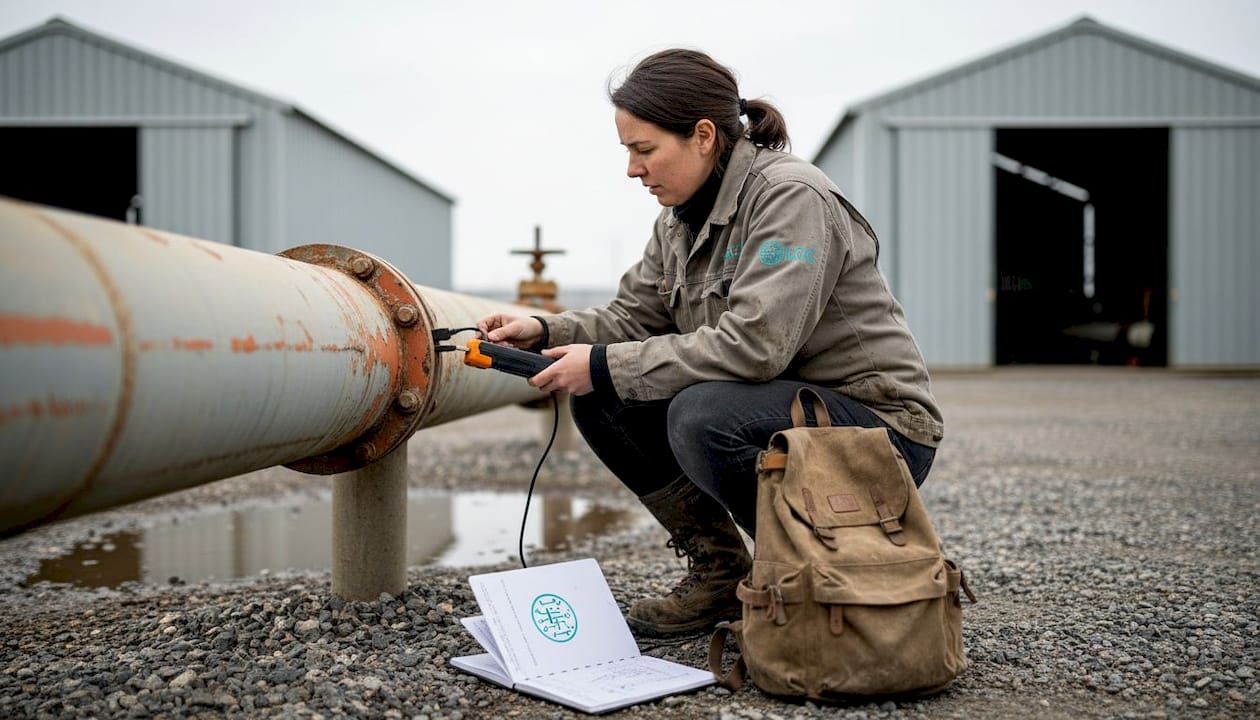
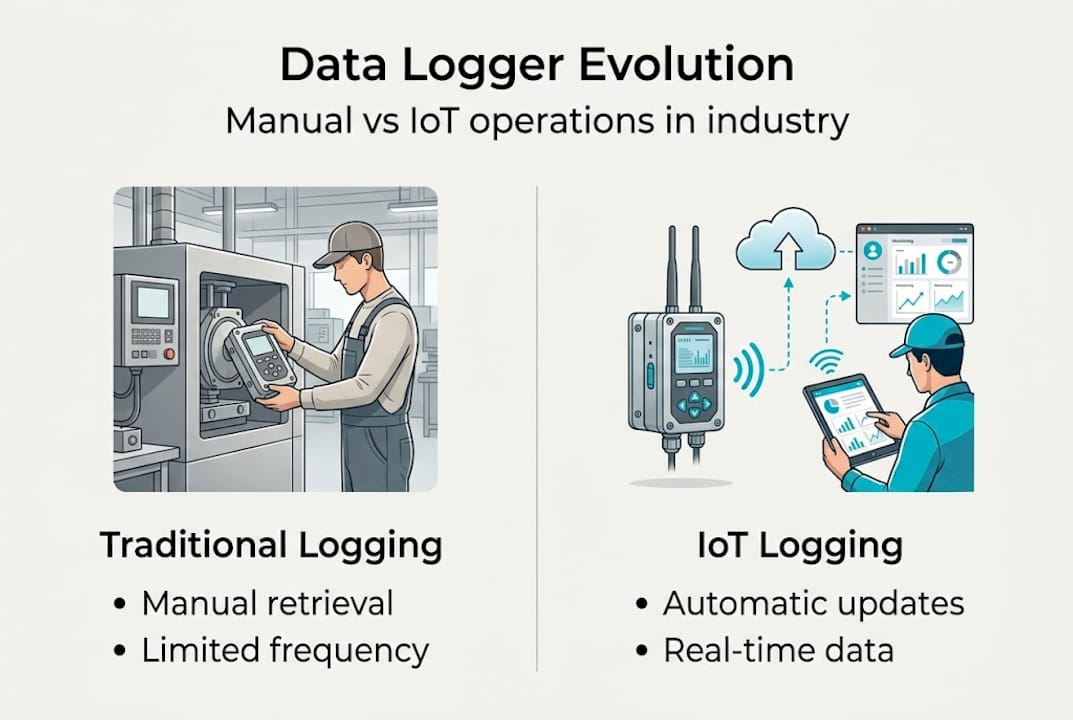
Traditional data logging required technicians to physically visit each monitoring point, download stored data, and manually process it. This approach had three fundamental weaknesses: it was slow, expensive, and blind to real-time events. A pressure anomaly that developed between site visits could go undetected for days, causing significant damage or loss before anyone noticed.
IoT-enabled loggers eliminate this gap entirely. The shift to real-time remote monitoring reduces labor costs and enables automated alerts the moment a parameter crosses a threshold. Your operations team receives a notification before a problem becomes a crisis. Cloud dashboards give managers a live view of all monitored assets without leaving the control room.
What changes when you move from manual to IoT-based logging:
- Alerts trigger automatically on threshold breaches, not after the next site visit
- Data is timestamped and cloud-stored, creating a continuous compliance record
- Remote diagnostics reduce truck rolls and associated field labor costs
- Historical trend analysis becomes possible, enabling predictive maintenance
The accuracy difference is also significant. Sensor accuracy varies widely, with low-cost sensors showing error rates of ±8-12% compared to ±1-2% for quality industrial sensors. In water quality monitoring or energy billing applications, that gap is not acceptable.
| Attribute | Traditional logger | IoT-enabled logger |
|---|---|---|
| Data retrieval | Manual, on-site | Automatic, remote |
| Alert capability | None | Real-time threshold alerts |
| Sensor accuracy | ±8-12% (low-cost) | ±1-2% (industrial grade) |
| Battery life | 1-3 years typical | Up to 12 years |
| Compliance support | Manual log sheets | Automated audit trail |
Pro Tip: When evaluating the evolution of IoT data loggers, calculate the total cost of manual data collection, including labor, travel, and error correction. In most cases, automation with data loggers pays for itself within 12 to 18 months.
Implementation challenges and best practices
Adopting advanced data loggers is not without its hurdles. Let’s tackle what holds organizations back and how to overcome these barriers.
The three most common obstacles are upfront costs, technical expertise gaps, and data management complexity. High upfront costs and expertise gaps remain the primary barriers to adoption, along with the challenge of integrating logger data with existing operational systems and extracting actionable insights from large data volumes.
Cost concerns are real but often overstated when viewed in isolation. The relevant comparison is not hardware cost versus zero. It is hardware cost versus the ongoing expense of manual monitoring, plus the cost of incidents that real-time alerts would have prevented. When framed correctly, the ROI case for industrial IoT loggers is strong in most utility and energy contexts.
The numbered steps below outline a proven implementation path:
- Define priority use cases first. Identify the two or three operational pain points where continuous monitoring will deliver the clearest, fastest return.
- Run a pilot project. Deploy a small cluster of loggers at a high-value monitoring point before scaling. This validates connectivity, sensor accuracy, and alert logic in your specific environment.
- Invest in integration. Ensure logger data flows into your existing SCADA, ERP, or asset management systems. Siloed data limits value.
- Train your team. Staff who understand how to interpret dashboards and respond to alerts are as important as the hardware itself.
- Partner with experienced vendors. A case study on EMS implementation in a manufacturing context shows how expert deployment support accelerates time-to-value.
“Integration with AI and remote sensing tools is where the next layer of value emerges. The logger is the data source. The intelligence layer is what turns that data into decisions.”
Edge cases matter too. Extreme temperatures, corrosive environments, and areas with limited connectivity all require specific hardware configurations. Review edge case details for your deployment context before finalizing hardware selection. Explore the range of IoT data logger issues that field teams encounter most often to build a realistic deployment plan.
The practical truth: What we’ve learned deploying data loggers in the field
With the fundamentals and pitfalls covered, here is our take after years in the field.
The most consistent finding we have across deployments is this: technology is rarely the limiting factor. The organizations that get the most from their data loggers are the ones that invest as much in clarity of purpose and staff adoption as they do in hardware. Teams that know exactly what they are monitoring, why it matters, and what action to take when an alert fires consistently outperform those running more sophisticated setups with less operational alignment.
There is also a persistent misconception that more sensors and more data automatically mean better outcomes. It does not. We have seen operations drown in data while missing the two or three metrics that actually drive decisions. Simpler, well-configured systems with reliable sensors and clear alert logic often outperform technically impressive but poorly focused deployments.
The transformative value of lessons from IoT logger deployments comes when data logging is tightly aligned with operational priorities, not when it is treated as a standalone technology project. Start focused, prove value, then scale.
Unlock greater efficiency with ThingsLog industrial solutions
To turn these concepts into real operational gains, here is how we help organizations get started.
ThingsLog designs and deploys turnkey IIoT monitoring solutions built specifically for water utilities, energy operators, and agricultural organizations. Our platform connects rugged, field-proven data loggers to a cloud analytics environment that gives your team real-time visibility and automated alerting without complexity.
From understanding how our IIoT platform works to exploring our cloud and mobile platform, we offer the integration support and sector expertise that turns a pilot project into a scalable operational asset. If energy efficiency is your priority, our energy consumption monitoring solution is purpose-built to identify waste and deliver measurable savings from day one. Let’s build your data-driven operation together.
Frequently asked questions
What parameters can industrial data loggers monitor?
Data loggers monitor parameters like pH, turbidity, TDS, DO, and temperature for water quality compliance and leak detection, as well as voltage, current, and energy consumption for power management.
How much can data loggers reduce operational costs?
In water utilities, continuous monitoring can reduce non-revenue water by 15-30%, while energy deployments have delivered $46,000 in annual savings plus utility rebates in documented cases.
What challenges do organizations face when adopting data loggers?
The primary barriers are upfront costs, expertise gaps, and data management complexity, all of which are best addressed through phased rollouts and experienced implementation partners.
How long do industrial data logger batteries last?
Many industrial IoT loggers support battery life up to 12 years when configured with ultra-low power consumption protocols, making them practical for remote and hard-to-access monitoring points.
What is the difference between traditional and IoT-enabled data loggers?
Traditional loggers require manual on-site retrieval and miss real-time events, while IoT loggers transmit remotely with automated alerts and sensor accuracy of ±1-2% versus ±8-12% for low-cost alternatives.


