
Most people assume data logging means a technician drives to a remote site, downloads files from a device, and drives back. That assumption costs utilities time, money, and missed alerts. An IoT data logger is a device that records sensor data over time and transmits it wirelessly via internet connectivity to cloud platforms for real-time monitoring and analysis, unlike traditional loggers that store data locally for later retrieval. For water utility managers and environmental scientists, this distinction is not a minor technical detail. It defines whether you catch a contamination spike in seconds or discover it days later during a routine site visit.
Table of Contents
- How IoT data loggers work: From sensor to cloud
- Key use cases: Water, energy, and environmental monitoring
- Performance benchmarks and reliability factors
- Risks, challenges, and expert solutions
- What most people miss about IoT data loggers in field operations
- Harness IoT for reliable remote monitoring
- Frequently asked questions
Key Takeaways
| Point | Details |
|---|---|
| Instant, remote monitoring | IoT data loggers send sensor data wirelessly to the cloud, enabling immediate remote access and analysis. |
| Real-world reliability | With up to 12-year battery life and robust ruggedization, IoT data loggers thrive even in harsh utility and natural environments. |
| Versatile applications | They track water quality, energy usage, and environmental factors for smarter compliance and resource management. |
| Pro-level risk mitigation | Advanced models use edge computing and dual connectivity to overcome outages, sensor wear, and cyber threats. |
How IoT data loggers work: From sensor to cloud
Now that we’ve outlined the IoT data logger’s basic definition and importance, let’s break down how these devices actually operate in the field.
At its core, an IoT data logger combines three functional layers: sensing, processing, and communication. Understanding each layer helps you make better procurement and deployment decisions.
The three core layers:
- Sensors measure physical parameters, such as pH, pressure, temperature, or flow rate, and convert them into electrical signals.
- Embedded processor conditions and digitizes those signals, applies calibration offsets, and stores readings in a local buffer. This buffer is critical because it protects data during brief connectivity gaps.
- Wireless connectivity module transmits buffered data to a cloud platform. Depending on the deployment environment, this can be WiFi, 4G/GSM, NB-IoT, or LoRaWAN.
Once data reaches the cloud, it populates real-time dashboards, triggers threshold alerts, and feeds into compliance reporting tools. You can review a what is a data logger overview for a deeper look at how these components interact.
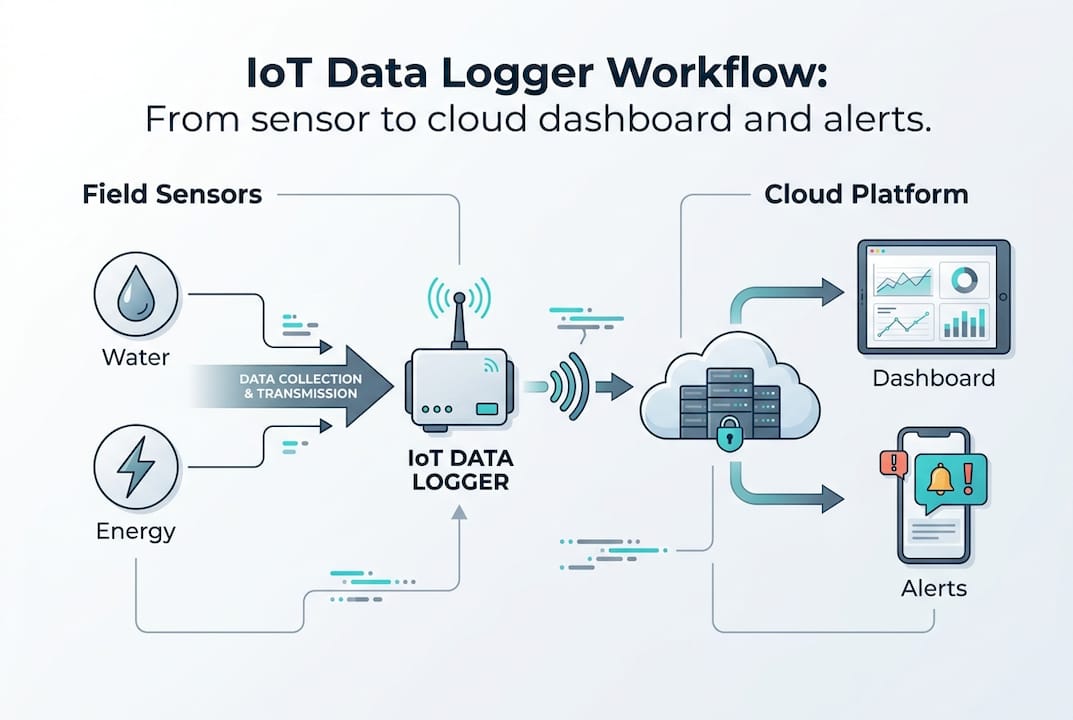
Data travels from sensors via wireless internet connectivity to cloud platforms for remote, real-time monitoring and analysis, eliminating the latency that comes with manual retrieval.
The practical result is significant. Field teams no longer need to visit every installation to confirm normal operation. Alerts go directly to operations staff the moment a reading crosses a defined threshold. For a water utility managing dozens of remote reservoirs, this reduces site visits by a measurable margin and allows staff to focus on interventions rather than data collection.
Explore IoT data logger basics to see how different connectivity protocols suit different field scenarios.
“The move from store-and-retrieve to transmit-in-real-time is not just a convenience upgrade. It is a fundamental change in how utilities and scientists respond to field conditions.”
Pro Tip: For remote locations with unreliable cellular coverage, choose loggers that support dual connectivity, such as WiFi plus GSM, so the device automatically falls back to the available network without losing a single reading.
Key use cases: Water, energy, and environmental monitoring
With a clear grasp of the core technology, let’s explore where and how IoT data loggers deliver value for water, energy, and the environment.
IoT data loggers are used across three primary domains, each with distinct parameter sets, compliance requirements, and operational priorities.
Water quality monitoring is the most parameter-intensive application. Sensors track pH, turbidity (ranging from 0.1 to 1000 NTU), total dissolved solids (TDS), dissolved oxygen (DO), and temperature across a 0 to 60°C range. These devices are deployed for remote monitoring of reservoirs, rivers, tanks, and sewers, enabling real-time alerts and compliance logging. Leak detection and pump efficiency tracking add further operational value. See how IoT water monitoring is applied across intelligent water portfolios.
Energy monitoring targets consumption patterns and power quality in manufacturing facilities, new buildings, hotels, and closed complexes. Loggers capture voltage, current, power factor, and energy consumption over time. The goal is identifying waste, optimizing load schedules, and proving compliance with energy efficiency targets. An energy optimization case study illustrates how real-time data drives measurable cost reductions.

Environmental monitoring covers temperature, humidity, air quality (particulate matter, CO2, VOCs), and atmospheric pressure. Scientists and research organizations use these deployments for long-term trend analysis and regulatory reporting.
| Domain | Key parameters | Primary value |
|---|---|---|
| Water quality | pH, turbidity, TDS, DO, temperature | Compliance, contamination alerts |
| Energy | Voltage, current, power factor, kWh | Waste reduction, load optimization |
| Environment | Temperature, humidity, air quality | Trend analysis, regulatory reporting |
Across all three domains, immediate threshold notifications are the shared operational advantage. When a contaminant spike or equipment fault occurs, the logger triggers an alert before the problem escalates. Explore dedicated water quality monitoring resources for parameter-specific guidance.
Performance benchmarks and reliability factors
Understanding where IoT data loggers are used leads to another critical question: how reliably can they perform in diverse, sometimes harsh, conditions?
Field performance data gives a clearer picture than marketing specifications alone. Based on published research across real deployments, IoT data loggers demonstrate the following performance characteristics in harsh conditions:
- Battery life: 5 to 7 years with hourly sampling; up to 12 years with lithium batteries at low sampling frequencies
- Data success rate: 92% to 99.4% across varied network conditions
- Transmission latency: 1.8 seconds mean latency for data delivery
- Environmental rating: IP68 ingress protection, stable operation from -20°C to +60°C
These figures matter because they directly affect total cost of ownership. A logger that requires battery replacement every two years in a hard-to-reach location carries a very different maintenance burden than one rated for a decade of operation.
| Metric | Typical range | Best-case scenario |
|---|---|---|
| Battery life | 5 to 7 years | Up to 12 years (lithium, low freq) |
| Data success rate | 92% | Up to 99.4% |
| Transmission latency | ~1.8 seconds mean | Sub-second in ideal conditions |
| Operating temperature | -20°C to +60°C | Stable across full range |
IP68 certification means the device can be submerged in water beyond one meter for extended periods. For installations near waterways, in valve chambers, or in outdoor enclosures exposed to seasonal flooding, this rating is not optional. It is a baseline requirement.
Review the full telemetry product overview to match specific models to your site’s environmental conditions. For methodology and context on these benchmarks, the data logging reliability section provides additional deployment guidance.
Pro Tip: Before finalizing a logger model, map your site’s temperature extremes and humidity levels across all seasons. A device rated for -20°C to +60°C may still underperform if installed inside a poorly ventilated enclosure that traps heat in summer.
Risks, challenges, and expert solutions
While performance is impressive, water and utility managers face practical challenges. Let’s look at common risks and how experts address them.
No technology operates without risk. IoT data loggers face four primary challenge categories in real deployments:
- Sensor calibration drift: Physical and chemical sensors degrade over time. A pH probe exposed to aggressive wastewater will drift faster than one in clean reservoir water. Without scheduled recalibration, readings become unreliable.
- Network outages: Cellular coverage gaps, antenna damage, or temporary service interruptions can break the data stream. Without local buffering, readings during outages are permanently lost.
- Environmental wear: Vibration, UV exposure, condensation, and chemical contact degrade enclosures and connectors over multi-year deployments.
- Cybersecurity threats: Remote devices connected to the internet are potential attack surfaces. Tampering and man-in-the-middle (MITM) attacks are documented risks in industrial IoT environments.
Issues include sensor degradation, network outages, harsh environments, and security risks; solutions include edge computing, dual connectivity, self-calibration routines, and blockchain-based data integrity.
Modern IoT data loggers address these risks through several design features. Redundant connectivity, combining GSM with WiFi or LoRaWAN, ensures the device always has a fallback path. Onboard data buffering preserves readings during outages and syncs them automatically when service restores. Automated sensor self-checks flag anomalous readings before they propagate into compliance reports.
Cloud security layers, including encrypted transmission and access controls, reduce exposure to unauthorized access. IoT loggers enable real-time cloud dashboards and alerts but demand network redundancy and strong security to deliver on that promise reliably.
For deployment-specific guidance, the IoT data logger applications library covers scenarios from water networks to industrial energy systems. You can also review available IoT logger solutions to see how these design features are implemented across product lines.
Pro Tip: Set up automated alerts for signal loss, not just threshold breaches. A logger that goes silent is just as operationally dangerous as one reporting an out-of-range value.
What most people miss about IoT data loggers in field operations
After working across water utility and environmental monitoring deployments, we’ve observed a consistent pattern: purchasing teams focus on hardware specifications and unit cost, then underestimate everything that happens after installation.
The hardware is the smallest part of the value equation. Real return on investment comes from the software layer, specifically dashboards that surface actionable trends, alert logic that filters noise from genuine events, and integrations that push data into existing SCADA or compliance systems. A logger with excellent battery life but limited analytics capability delivers far less operational value than a slightly more expensive device with a mature software ecosystem.
Network redundancy is the most frequently underestimated deployment requirement. We see this repeatedly. A site that has reliable 4G coverage during commissioning may experience seasonal dead zones, infrastructure changes, or interference that degrades connectivity months later. Building in a secondary network path from day one costs less than retrofitting it after the first major data gap.
Lifecycle planning is equally overlooked. Sensor maintenance schedules, battery replacement logistics, firmware update procedures, and cybersecurity patch cycles all need to be defined before deployment, not after the first failure. Explore advanced data logger uses to see how long-term deployments are structured for sustained reliability.
Flexibility beats upfront cost savings every time. Scalable, wireless architectures that can absorb new sensor types or expanded network coverage will outperform cheaper, rigid systems within two to three years of deployment.
Harness IoT for reliable remote monitoring
With these insights in mind, here’s how you can leverage cutting-edge IoT monitoring with ThingsLog to future-proof your operations.
At ThingsLog, we design IoT data loggers built for the conditions you actually face: remote reservoirs, industrial energy networks, and long-term environmental research sites. Our devices support 4G, NB-IoT, and LoRaWAN connectivity, giving you the network flexibility that real-world deployments demand.
Explore our remote smart water metering solutions for intelligent water portfolio management, or review our energy monitoring solutions for manufacturers, hotels, and closed complexes. Environmental scientists and research organizations can find dedicated tools within our air quality monitoring portfolio. Contact us to discuss your deployment requirements and see our hardware in action.
Frequently asked questions
How is an IoT data logger different from a traditional data logger?
An IoT data logger transmits data wirelessly in real-time to cloud platforms for immediate access, while traditional data loggers store data locally and require manual retrieval during site visits.
What environmental parameters can IoT data loggers monitor?
IoT data loggers monitor water quality parameters including pH, turbidity, TDS, dissolved oxygen, and temperature, as well as pressure, flow, air quality, and humidity for regulatory compliance and resource management.
What is the battery life of a typical IoT data logger?
With hourly sampling, batteries last five to seven years; in low-frequency, lithium-powered models, up to twelve years of operation is achievable without replacement.
How do IoT data loggers handle network outages?
Modern loggers use local buffering during outages and sync stored readings automatically once connectivity is restored, ensuring no data is permanently lost during brief service interruptions.


