
TL;DR:
- 4G data logging offers real-time, reliable, high-throughput data transmission crucial for infrastructure management.
- Successful deployment depends on signal quality, environment considerations, power management, and security protocols.
- Organizations should view 4G as a foundation for ongoing digital transformation and smarter decision-making.
Most organizations still treat wireless data logging as a single, undifferentiated category. They assume any cellular connection delivers roughly the same result. That assumption costs them. 4G data logging operates on an entirely different level from legacy GSM or 3G systems, delivering real-time data transmission, higher throughput, and the scalability that modern infrastructure demands. In this article, we break down what 4G data logging is, how it works, where it creates measurable business value, and what you need to know before deploying it across your operations.
Table of Contents
- What is 4G data logging?
- Why 4G data logging is a game-changer for infrastructure operations
- Key technical considerations and edge cases
- Best practices for implementing 4G data logging solutions
- A fresh perspective: Why 4G is only the beginning
- Unlock the full power of 4G data logging with ThingsLog
- Frequently asked questions
Key Takeaways
| Point | Details |
|---|---|
| True real-time monitoring | 4G data logging enables fast, large-scale, and continuous operations data collection. |
| Handles industrial challenges | Robust devices and smart design address power, signal, and environment constraints in critical sectors. |
| Strategic business benefits | Deploying 4G data logging can drive efficiency, compliance, predictive maintenance, and cost savings. |
| Future-ready foundations | Viewing 4G as a launchpad for evolving technologies keeps your infrastructure adaptable. |
What is 4G data logging?
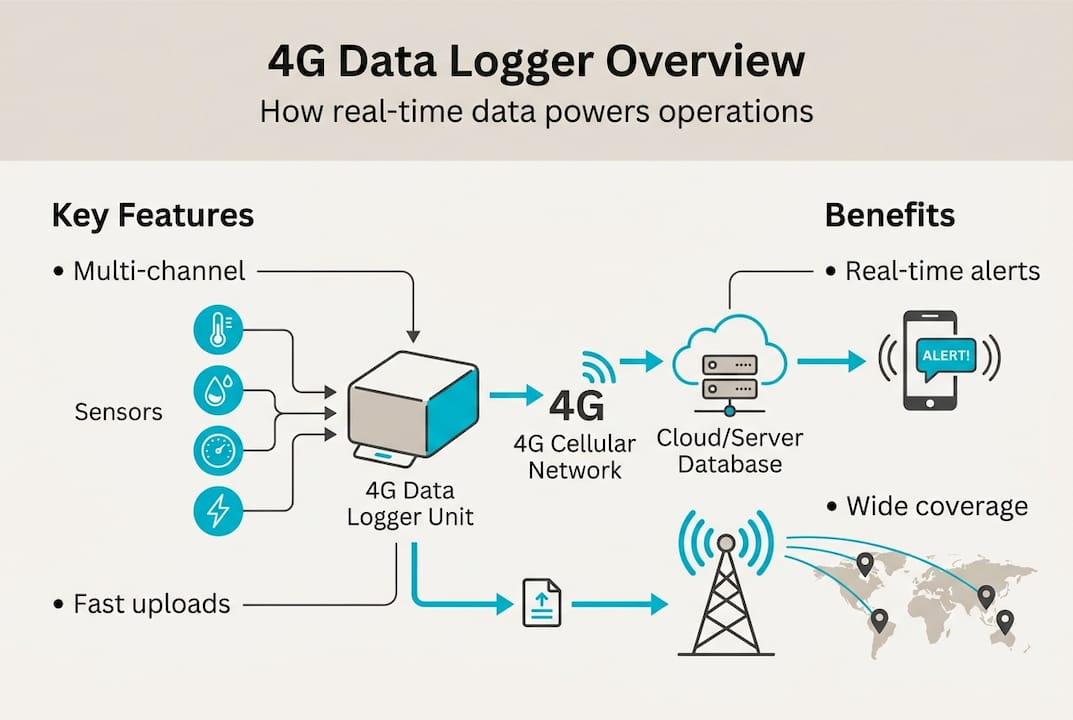
A 4G data logger is a device that collects sensor data at defined intervals, stores it locally, and transmits it to a cloud platform over a 4G LTE (Long-Term Evolution) cellular network. The architecture is straightforward: sensors feed raw measurements into the logger, which processes and timestamps the data, then pushes it upstream via an embedded 4G modem. Cloud software handles storage, visualization, and alerting.
The key difference from older systems is speed and reliability. GSM data logging relied on 2G networks with narrow bandwidth and high latency. 3G improved this but still imposed real limits on data volume and response time. LTE Cat-4, the most common 4G standard in industrial loggers, supports up to 150 Mbps download and 50 Mbps upload. That is a fundamental shift in what is possible.
Core components of a 4G data logging system:
- Sensor inputs: Analog, digital, pulse, or RS-485 interfaces for temperature, pressure, flow, energy, and GPS
- Local storage: On-board flash memory buffers data during connectivity gaps
- 4G LTE modem: Handles cellular registration, data transmission, and remote commands
- Power management: Battery, solar, or mains power with ultra-low standby modes
- Cloud platform: Receives, stores, and visualizes data; triggers alerts and reports
To understand how this translates in practice, consider real-world benchmarks. GPS tracking applications consume less than 3 MB per day over 4G. Fuel monitoring loggers achieve 3 to 11 years of battery life depending on reporting frequency and network conditions.
| Technology | Max downlink speed | Typical latency | Battery efficiency |
|---|---|---|---|
| GSM (2G) | 114 Kbps | 300-1000 ms | Low |
| 3G (HSPA) | 42 Mbps | 50-100 ms | Moderate |
| 4G LTE Cat-4 | 150 Mbps | 10-50 ms | High (optimized) |
| NB-IoT | 250 Kbps | 1-10 s | Very high |
The ThingsLog 4G data logger exemplifies this architecture, combining multi-channel sensor inputs with LTE Cat-4 connectivity and cloud integration in a single industrial-grade unit. Common applications span water utility metering, energy substation monitoring, cold chain logistics, remote fuel tank management, and environmental compliance reporting.
With the basics established, it is important to see how 4G data logging drives value for today’s organizations.
Why 4G data logging is a game-changer for infrastructure operations
Operational efficiency in critical infrastructure depends on one thing above all else: knowing what is happening before it becomes a problem. 4G data logging makes that possible at scale.
Water networks globally have deployed hundreds of thousands of 4G data loggers, demonstrating that this technology is not experimental. It is proven, scalable, and operationally mature. The same pattern holds in energy, logistics, and cold chain sectors.
Key operational advantages:
- Real-time visibility: Data arrives in seconds, not hours, enabling immediate response to anomalies
- Remote management: Configure, update, and diagnose devices without site visits
- Scalable deployment: Add hundreds of nodes without redesigning the network architecture
- Predictive maintenance: Trend data identifies equipment degradation before failure occurs
- Regulatory compliance: Automated, timestamped records satisfy audit requirements
Compared to NB-IoT alternatives, 4G LTE Cat-4 delivers significantly higher throughput, which matters when you need to transmit waveform data, high-frequency readings, or firmware updates to remote devices. NB-IoT excels in ultra-low power scenarios with infrequent, small payloads. 4G is the right choice when data volume or response speed is a priority.
| Metric | 4G LTE Cat-4 | NB-IoT | Legacy GSM |
|---|---|---|---|
| Throughput | High (150 Mbps DL) | Very low (250 Kbps) | Very low (114 Kbps) |
| Latency | 10-50 ms | 1-10 s | 300-1000 ms |
| Battery life | 3-11 years (optimized) | Up to 10+ years | 1-3 years |
| Cost per device | Moderate | Low | Low |
| Best use case | High-volume, real-time | Low-frequency sensors | Legacy replacement |
For multi-channel logging across large infrastructure assets, 4G’s throughput advantage is decisive. A single logger can aggregate data from multiple sensors simultaneously and push consolidated reports to the cloud without queuing delays.
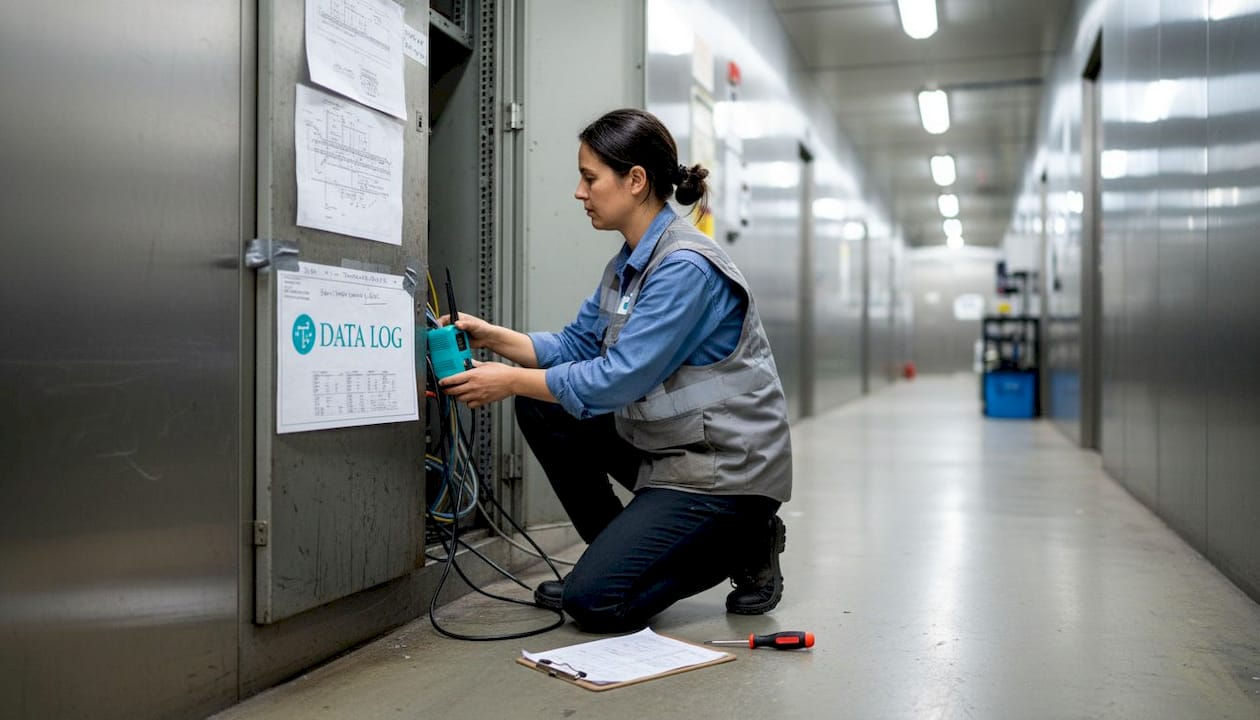
Pro Tip: If your operation requires both real-time alerting and long battery life, consider a hybrid approach. Use 4G for primary transmission and configure local buffering with extended sleep intervals during off-peak periods. This can extend battery life significantly without sacrificing data integrity.
For remote energy monitoring, the business case is clear. Faster data means faster response to consumption spikes, equipment faults, and billing anomalies. Organizations report measurable reductions in unplanned downtime and energy waste within the first months of deployment.
These advantages are significant, but practical deployment involves real-world constraints that must be navigated effectively.
Key technical considerations and edge cases
No technology performs uniformly across every environment. 4G data logging is powerful, but deployment success depends on understanding where it can be stressed and how to mitigate those risks.
Network limitations are the most common source of field problems. Poor signal increases power draw as the modem repeatedly attempts to connect or retransmit. Congestion and interference reduce effective throughput, even in areas with strong signal. In locations with no coverage at all, local storage becomes essential.
Five technical factors to evaluate before deployment:
- Coverage mapping: Verify 4G signal strength at each planned device location, not just at the nearest tower
- Signal-to-noise ratio (SINR): Low SINR causes retransmissions, higher power consumption, and data gaps
- Operating temperature range: Industrial loggers must handle wide temperature swings; look for devices rated from -40°C to 70°C
- Power architecture: Determine whether mains, battery, or solar power is available and plan accordingly
- Antenna selection: External MIMO (Multiple Input Multiple Output) antennas improve signal quality in marginal coverage areas
“Network conditions directly affect device power consumption and data reliability. Poor SINR forces more retries, congestion limits throughput, and gaps in coverage require robust local buffering strategies.”
For pressure monitoring data loggers deployed in remote pipeline networks, external antennas are often non-negotiable. A device with a strong internal antenna may still underperform in a buried or shielded enclosure.
Power management deserves careful planning. Solar panels paired with BP12 backup batteries provide reliable operation in off-grid locations. The logger’s firmware should manage transmission schedules to avoid peak power draw during low-light periods.
Cold chain applications add another layer of complexity. Temperature sensors must maintain calibrated accuracy across the full operating range of the storage environment, and the logger itself must function reliably in those same conditions.
Pro Tip: For industrial device durability in harsh environments, always specify DIN-rail mountable enclosures with IP65 or higher ingress protection ratings. This prevents moisture and particulate contamination from degrading electronics over multi-year deployments.
Understanding these constraints allows leaders to move into implementation with clear eyes. Let’s look at proven best practices for deploying 4G data logging.
Best practices for implementing 4G data logging solutions
A well-planned deployment separates organizations that extract lasting value from those that struggle with reliability issues and escalating maintenance costs. These practices reflect what works in real infrastructure environments.
Deployment workflow:
- Pilot test first: Deploy 5 to 10 devices across representative site conditions before full rollout. Validate signal quality, battery performance, and data accuracy.
- Network validation: Conduct SINR measurements at each site. Flag locations that need external antennas or alternative connectivity.
- Phased rollout: Expand in stages, resolving issues at each phase before scaling further.
- Cloud integration: Connect loggers to your RCMS (Remote Configuration and Management System) from day one. This enables firmware updates, threshold configuration, and diagnostics without site visits.
- Security hardening: Enable data encryption in transit (TLS 1.2 or higher), enforce device authentication, and establish a firmware update policy.
Security is not optional in critical infrastructure. Loggers connected to operational technology networks must be treated with the same rigor as any industrial control system endpoint.
Ongoing operational practices:
- Schedule regular battery health checks and replace units proactively based on capacity trends
- Configure redundant alert channels (SMS, email, API) so no critical event goes unnoticed
- Maintain a spare device inventory for rapid field replacement
- Review data quality metrics monthly to catch sensor drift or transmission anomalies early
- Document device evolution insights and configuration changes in a centralized asset register
Vendor selection is equally important. Prioritize suppliers with proven industrial deployments, wide temperature ratings, and active fleet management support. Devices rated for -40°C to 70°C operation handle the full range of infrastructure environments without performance degradation.
For organizations pursuing energy optimization strategies, integrating 4G loggers with cloud analytics platforms unlocks automated reporting, consumption benchmarking, and anomaly detection. These capabilities move operations from reactive to genuinely predictive.
By following these best practices, organizations can maximize both immediate and long-term returns from their 4G data logging investments.
A fresh perspective: Why 4G is only the beginning
Most business leaders we work with approach 4G data logging as a destination. They want to replace aging GSM systems, achieve compliance, and move on. We understand that instinct, but it misses the larger opportunity.
4G is a foundation, not a finish line. The organizations that extract the most value treat their logging infrastructure as an adaptive platform. They design for sensor upgrades, plan for 5G migration paths, and build data pipelines that can absorb new inputs without architectural redesign.
What often gets overlooked is the human side. Hardware is the easy part. The harder challenge is building internal capability to act on the data. That means training operations teams to interpret trend data, establishing escalation protocols for alerts, and creating feedback loops between field observations and system configuration.
The organizations that lead in infrastructure efficiency are not necessarily those with the most advanced hardware. They are the ones that built a culture of data-driven decision-making alongside their technology investment. Next-gen energy monitoring is one example of where this mindset produces compounding returns over time.
Treat 4G not as a procurement decision but as the first step in a longer transformation.
Unlock the full power of 4G data logging with ThingsLog
If you are ready to move beyond legacy monitoring and build infrastructure that responds in real time, ThingsLog is built for exactly that.
Our platform connects industrial-grade hardware with a cloud mobile platform designed for fleet-scale deployments across utilities, energy, agriculture, and public sector operations. From pilot to full rollout, we provide tailored configuration, proven connectivity options, and ongoing support. Explore how our IIoT platform works and see how organizations like yours are turning sensor data into operational advantage. Visit ThingsLog to connect with our team and find the right solution for your infrastructure.
Frequently asked questions
What kind of data can a 4G data logger collect?
A 4G data logger captures a wide range of measurements including temperature, pressure, energy consumption, GPS location, flow rates, and tank levels, depending on sensor configuration. Empirical benchmarks confirm use cases spanning GPS tracking, fuel monitoring, and energy management in deployed systems.
How does 4G data logging ensure data integrity during signal loss?
When the 4G signal drops, the device writes data to local flash storage and holds it until connectivity is restored, then transmits the buffered records in sequence. No coverage requires local storage and buffering as a standard design requirement for reliable field deployments.
What is typical battery life for a 4G data logger in critical infrastructure?
Battery life ranges from 3 to 11 years depending on logging interval, transmission frequency, signal quality, and device model. Optimizing sleep cycles and transmission schedules is the most effective way to extend operational life.
How does 4G data logging compare to NB-IoT for energy use?
LPWAN for ultra-low power scenarios gives NB-IoT an edge in battery efficiency, but LTE Cat-4 delivers significantly higher throughput for applications that require real-time data, large payloads, or rapid firmware updates.


