
TL;DR:
- LoRaWAN offers low-cost, long-range, low-power connectivity ideal for remote industrial sensors.
- It primarily suits applications requiring infrequent data transmission, not real-time or high-bandwidth uses.
- Proper planning, gateway placement, and ecosystem management are crucial for scaling and reliability.
Long-range wireless monitoring used to mean one thing: expensive infrastructure. Cellular modems, fiber backhaul, or costly licensed spectrum. LoRaWAN challenges that assumption directly. Built on sub-GHz unlicensed bands designed for low-power, wide-area communication, LoRaWAN delivers reliable data from remote sensors across kilometers without monthly carrier fees or complex wiring. For decision-makers in water utilities, energy management, and agriculture, this is not a minor footnote. It represents a fundamental shift in how critical infrastructure can be monitored at scale, at a fraction of the traditional cost. This guide breaks down the technology clearly and shows you where it fits, where it does not, and how real deployments are performing.
Table of Contents
- The fundamentals of LoRaWAN technology
- How LoRaWAN compares to other IoT connectivity options
- Security, scalability, and limitations in industrial deployments
- Industrial applications and real-world impact
- What most IoT guides miss about LoRaWAN
- Ready to power your next industrial IoT project?
- Frequently asked questions
Key Takeaways
| Point | Details |
|---|---|
| Long-range, low-power IoT | LoRaWAN enables reliable sensor communications over many miles while keeping batteries alive for years. |
| Ideal for industrial monitoring | Utilities, agriculture, and energy sectors use LoRaWAN to slash manual operations and boost real-time visibility. |
| Open, flexible infrastructure | LoRaWAN works on public or private networks without subscription fees, lowering barriers to deployment. |
| Built-in security features | AES-128 encryption and activation options make LoRaWAN suitable for critical infrastructure data. |
| Know the limits | Capacity, bandwidth, and coverage challenges exist—plan networks and deployments with these in mind. |
The fundamentals of LoRaWAN technology
Understanding LoRaWAN starts with separating two distinct layers. LoRa is the physical radio technology, a proprietary chirp spread spectrum modulation developed by Semtech. It handles the actual radio transmission. LoRaWAN is the network protocol layered on top, defining how devices communicate, how gateways relay messages, and how application servers process data.
The key technical characteristics that make this technology relevant to industrial IoT include:
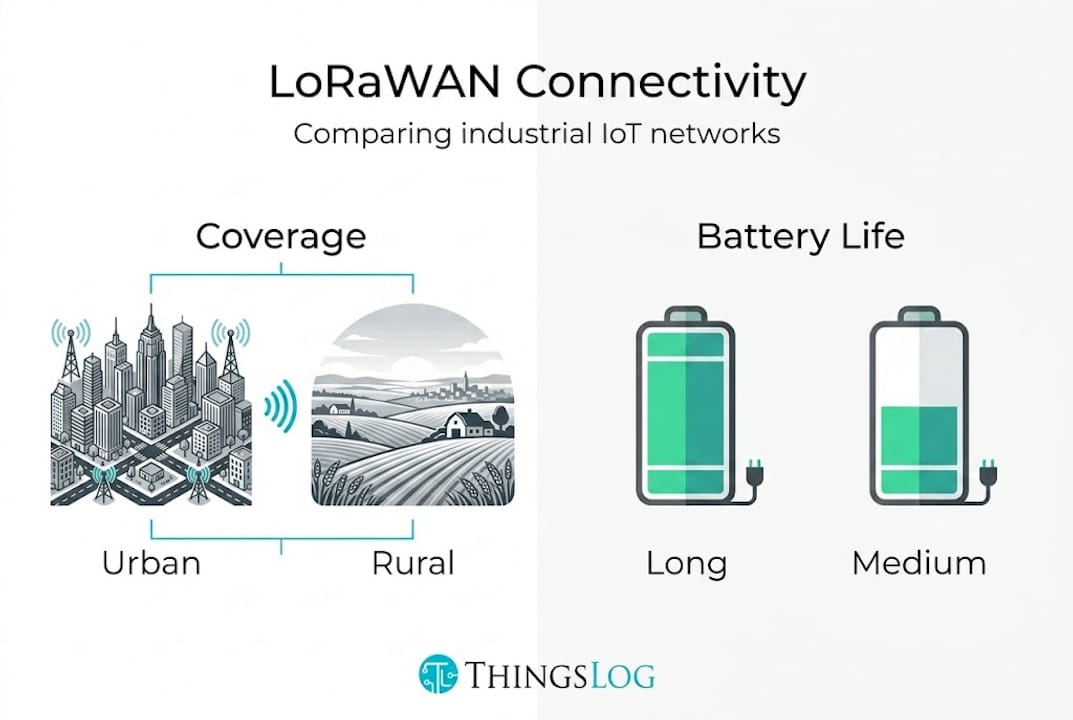
- Range: Up to 11 km in rural environments, 3-5 km in urban settings
- Power consumption: Ultra-low, enabling 5-15 year battery life on standard cells
- Data rates: 0.3 to 50 kbps, using sub-GHz ISM bands with chirp spread spectrum modulation
- Spectrum: Unlicensed, meaning no recurring fees for spectrum access
- Device classes: Class A (lowest power, uplink-triggered), Class B (scheduled downlink), Class C (near-continuous listening)
Class A is the standard for most industrial sensors. Devices transmit when they have data, then open two brief receive windows. This pattern keeps power consumption minimal, which is why multi-year battery life is achievable in the field.
The network architecture follows a star-of-stars topology. End devices transmit to one or more gateways simultaneously. Gateways forward packets to a network server, which deduplicates messages and routes them to an application server. This design means you can add gateways to expand coverage without reconfiguring devices.
The LoRaWAN ecosystem is on a steep growth trajectory. Industry forecasts project 125 million connected LoRaWAN devices by end of 2026, driven by a 25% compound annual growth rate. For industrial operators, that scale signals a mature, investable technology with a broad certified device ecosystem.
For teams managing distributed assets across large areas, these characteristics address a specific gap. You need infrequent readings, long battery operation, and low maintenance. LoRaWAN is architected precisely for that. Explore real-world LoRaWAN deployments to see how organizations are applying this in practice.
Pro Tip: When deploying end devices outdoors, select Class A with adaptive data rate (ADR) enabled. ADR automatically adjusts the spreading factor and transmission power based on link quality, extending battery life without sacrificing reliability.
How LoRaWAN compares to other IoT connectivity options
Now that you understand the basics, it is key to see where LoRaWAN stands relative to other low-power networks. The comparison matters because no single technology is optimal across all use cases.
| Feature | LoRaWAN | NB-IoT | Sigfox |
|---|---|---|---|
| Range | Up to 11 km rural | 1-10 km | Up to 50 km |
| Battery life | 5-15 years | 3-10 years | Up to 15 years |
| Data rate | 0.3-50 kbps | 20-250 kbps | 100 bps uplink |
| Spectrum cost | Free (unlicensed) | Carrier subscription | Subscription |
| Deployment model | Private or public | Carrier network | Proprietary network |
| Best fit | Static sensors, rural | QoS-sensitive, urban | Ultra-low data |
As the battery and range trade-off analysis confirms, LoRaWAN excels where flexible deployment and no recurring fees matter most, while NB-IoT suits applications requiring guaranteed quality of service and higher throughput but comes with carrier subscriptions.
Where LoRaWAN leads:
- No recurring fees: Deploy on private infrastructure without monthly data costs
- Flexibility: Build public or private networks depending on coverage needs
- Battery life: Best-in-class for infrequent sensor readings
- Best-fit sectors: Remote water utilities, agricultural field monitoring, energy asset tracking
Where LoRaWAN has limits:
- Not suitable for real-time video, voice, or high-frequency data streams
- Duty cycle regulations restrict transmission frequency per device
- Scaling beyond 1,000 nodes per gateway can introduce packet collisions
For a detailed side-by-side breakdown, the LoRaWAN vs NB-IoT comparison from our team covers the technical depth decision-makers need. If your operation already uses NB-IoT in some segments, reviewing NB-IoT applications alongside LoRaWAN use cases helps identify where each technology fits.
Pro Tip: For large outdoor deployments, invest in gateway placement modeling before purchase. A single well-positioned gateway can cover tens of square kilometers in flat terrain, dramatically reducing infrastructure cost compared to adding more nodes.
Security, scalability, and limitations in industrial deployments
Moving from comparisons to practical implementation, it is important to clarify LoRaWAN’s key strengths and real-world boundaries.

LoRaWAN’s security architecture is built on AES-128 encryption applied at two levels. AES-128 cryptography secures LoRaWAN with two session keys: one for network integrity and one for application-layer payload encryption. Devices join networks using either OTAA (Over-the-Air Activation, preferred for security) or ABP (Activation By Personalization). LoRaWAN v1.1 further improves roaming support and key management across network operators.
| Device class | Downlink latency | Power use | Typical application |
|---|---|---|---|
| Class A | Minutes to hours | Lowest | Most sensors, meters |
| Class B | Seconds (scheduled) | Moderate | Actuators, valves |
| Class C | Near-instant | Highest | Infrastructure control |
Knowing the class trade-offs helps you specify the right hardware before purchase, avoiding costly retrofits later.
Key limitations to plan for:
- Duty cycle regulations: Most regions restrict each device to less than 1% transmission time per hour, limiting how often sensors can report.
- Air-time constraints: Higher spreading factors (like SF12) mean longer air-time per message, which is 32 times longer than SF7 and can reduce network capacity in dense areas.
- Deep-indoor coverage gaps: Reinforced concrete and underground vaults may require dedicated indoor gateways.
- Capacity ceiling: Empirical testing confirms packet delivery rates above 89% at 1 km in rural settings, but dense deployments reduce message delivery rates due to collisions.
- Not for real-time control: If your application requires sub-second feedback loops, LoRaWAN is the wrong choice.
For teams working on low-power monitoring strategies, combining energy harvesting (solar, vibration) with Class A devices significantly reduces maintenance visits. Arduino’s documentation on edge cases and duty cycle limits provides useful regulatory detail per region.
A common mistake we see in early LoRaWAN deployments is over-specifying transmission frequency. Reducing report intervals from every 5 minutes to every 15 minutes triples effective network capacity and battery life simultaneously.
Industrial applications and real-world impact
Armed with a practical understanding of technology, compare these fundamentals against real industrial results. The numbers speak clearly.
In water utilities, LoRaWAN-enabled smart meters represent one of the strongest return-on-investment cases in IIoT. Yorkshire Water deployed 1.3 million LoRaWAN meters, saving 1.22 million liters of water per day through near-real-time leak detection and consumption analytics. Meter batteries in these installations operate for up to 15 years, meaning the network essentially runs maintenance-free for over a decade.
In agriculture, the Terranova pilot demonstrated a 34% reduction in irrigation water usage through LoRaWAN-connected soil moisture and weather sensors. Remote field monitoring eliminates manual inspection cycles across large farms, reducing both labor cost and resource waste in measurable terms.
In energy, LoRaWAN supports solar asset monitoring, transformer analytics, and grid-edge data collection. Fewer on-site truck rolls, automated anomaly alerts, and long-term consumption trend analysis all translate directly into operational savings.
Cross-sector impact summary:
- Water utilities: Multi-year battery meters, automatic leak alerts, billing accuracy improvement
- Agriculture: Real-time soil and weather data, irrigation automation, yield optimization
- Energy: Asset monitoring, consumption analytics, reduced field maintenance visits
- Smart cities: Street lighting control, environmental sensing, parking management
For organizations evaluating smart city LoRaWAN solutions, the urban infrastructure use cases align closely with utility monitoring fundamentals. Both LoRaWAN water metering and energy monitoring with LoRaWAN share the same architectural approach: low-power sensors, wide-area gateways, and cloud-based analytics.
What most IoT guides miss about LoRaWAN
Even with concrete results like Yorkshire Water’s deployment, many industrial teams approach LoRaWAN adoption with a pilot-first mindset and no clear path to scale. That gap between a 50-device pilot and a 50,000-device network is where real challenges emerge: gateway collision management, regulatory duty cycle quirks across regions, and fleet firmware updates at scale.
We consistently observe that teams who invest early in gateway positioning modeling, certified hardware selection, and energy harvesting design see dramatically lower maintenance overhead over the device lifecycle. The savings compound. A device that runs on solar with a 15-year battery backup requires almost zero field visits across its operational life.
The strategic factor most guides overlook is ecosystem risk. LoRaWAN is backed by the LoRa Alliance’s growing device ecosystem, which positions it as the leading standard for massive IoT connectivity. That means vendor diversity, component availability, and reduced lock-in risk compared to proprietary alternatives.
For teams reviewing operational learnings from LoRaWAN projects, the consistent theme is this: design for low-touch operation from day one. The technology rewards upfront planning with years of stable, cost-efficient monitoring.
Ready to power your next industrial IoT project?
For organizations ready to act on LoRaWAN’s advantages, having the right platform and technical partner makes the difference between a successful rollout and a costly rework.
At ThingsLog, we build IIoT platform solutions that support LoRaWAN alongside NB-IoT, LTE-M, Wi-Fi, and Ethernet, giving your team flexibility as connectivity needs evolve. Our smart water metering solutions and energy consumption monitoring tools are purpose-built for the exact use cases covered in this guide. Whether you are planning a pilot or scaling an existing network, our team is ready to walk you through a tailored solution demo.
Frequently asked questions
How does LoRaWAN achieve such long battery life in industrial sensors?
LoRaWAN’s low-power design and infrequent data transmissions allow sensors to run on standard batteries for 5-15 years in real deployments. Class A devices spend most of their time in deep sleep, only waking to transmit and briefly listen for a response.
What are the main weaknesses of LoRaWAN?
LoRaWAN is not suited for high-bandwidth or real-time applications and can struggle with deep-indoor coverage without additional gateways. Duty cycle regulations also limit how frequently each device can transmit.
Is LoRaWAN secure enough for critical infrastructure monitoring?
Yes. AES-128 encryption protects both network integrity and application payload, with OTAA providing strong device authentication. LoRaWAN v1.1 further strengthens key management for large-scale industrial networks.
Can LoRaWAN networks support thousands of devices reliably?
The protocol handles hundreds to thousands of devices per gateway, but collisions in dense deployments can reduce packet delivery rates. Careful gateway placement and ADR configuration are essential for maintaining reliability above 1,000 nodes.


