
TL;DR:
- LoRaWAN provides long-range, low-power connectivity ideal for large-scale remote infrastructure monitoring.
- Critical sectors like water utilities, energy, and agriculture benefit from LoRaWAN’s cost-effective, scalable IoT solutions.
- Hybrid network architectures with backup options enhance deployment reliability and operational longevity.
Choosing the right connectivity protocol for large-scale, hard-to-reach infrastructure is one of the most consequential decisions IoT professionals make. Long battery life, reliable coverage, low operating costs, and scalability across thousands of endpoints are non-negotiable for water utilities, energy managers, and agricultural operators. LoRaWAN (Long Range Wide Area Network) has emerged as the leading low-power wide-area network (LPWAN) technology precisely because it meets these demands without requiring expensive cellular subscriptions or constant maintenance cycles. This article examines proven LoRaWAN deployments across three critical sectors, providing data-backed results, expert-recommended decision frameworks, and practical guidance for professionals evaluating or scaling their remote monitoring programs.
Table of Contents
- Remote water utility monitoring and leak detection
- Energy management: Sub-metering and optimization
- Smart agriculture: Precision farming and livestock monitoring
- Beyond basics: Advanced features, edge cases, and choosing LoRaWAN
- What most IoT buyers miss about LoRaWAN deployments
- Explore LoRaWAN-powered solutions with ThingsLog
- Frequently asked questions
Key Takeaways
| Point | Details |
|---|---|
| Water utility impact | LoRaWAN delivers proven results in leak detection and water savings for utility companies at citywide scale. |
| Energy cost efficiency | Continuous sub-metering via LoRaWAN can reduce facility energy costs by up to 20 percent. |
| Agriculture transformation | Precision farming and livestock monitoring using LoRaWAN are scalable, durable, and already field tested. |
| Network flexibility | LoRaWAN supports public, private, and hybrid networks for tailored deployment in diverse environments. |
| Choosing the right protocol | Careful assessment is needed: LoRaWAN suits low-data, large-area use cases while other options excel in high-data scenarios. |
Remote water utility monitoring and leak detection
Building on the introduction, let’s explore how LoRaWAN delivers on its promise in water utilities, with large-scale deployments and proven outcomes.
Non-Revenue Water (NRW), the volume of treated water lost before it reaches paying customers, costs utilities billions of dollars annually. Reducing NRW requires continuous, accurate, and affordable monitoring across networks that often span hundreds of square kilometers. LoRaWAN enables this through advanced metering infrastructure (AMI), supporting pressure sensors, flow meters, and leak detectors on 10 to 15 year battery life, across both public and private networks.
The most compelling validation comes from a large-scale deployment at Yorkshire Water. They deployed 1.3 million smart meters, identified over 1,000 leaks in early network operation, saved 1.22 megaliters per day initially, and projected an 8 megaliters per day leakage reduction at full scale, all with 15-year battery life on end devices. That is infrastructure-level impact achieved without running fiber or cellular lines to every meter.
“The ability to pinpoint leaks remotely, at scale, without dispatching crews, fundamentally changes the economics of water loss management.”
Key outcomes enabled by LoRaWAN in water utilities:
- Real-time leak detection with automated alerts
- Pressure and flow anomaly identification across distribution zones
- Smart water metering with minimal truck-roll requirements
- Compatibility with both private utility networks and public LoRaWAN infrastructure
- Support for IoT in smart water utilities across urban and rural service areas
| Metric | Before LoRaWAN AMI | After LoRaWAN AMI |
|---|---|---|
| Leak detection speed | Days to weeks | Hours to days |
| Meter read frequency | Monthly manual | Continuous automated |
| Battery replacement cycle | 5-7 years | 10-15 years |
| NRW reduction potential | Baseline | Up to 8 ML/day |
Pro Tip: When planning a LoRaWAN water deployment, prioritize battery life over sensor density in the first phase. A sparse network of long-life sensors delivers faster ROI than a dense network requiring frequent maintenance visits. You can always add nodes as your private network infrastructure matures.
For utilities still relying on manual reads or older AMI technologies, LoRa-enabled water meters offer a direct upgrade path with minimal civil works.
Energy management: Sub-metering and optimization
Just as water utilities benefit from granular monitoring, energy managers leverage LoRaWAN to optimize consumption and reduce costs.
Sub-metering, the practice of measuring energy consumption at the circuit, machine, or zone level rather than just at the main meter, is where LoRaWAN creates measurable financial value. Traditional sub-metering required wired installations that were costly and disruptive. LoRaWAN sensors change that equation entirely. Industry data shows that LoRaWAN-enabled sub-metering and HVAC optimization can deliver 15 to 20 percent electricity savings, with manufacturing facilities tracking production-line energy-per-unit KPIs using wireless sensor arrays.
Common LoRaWAN energy monitoring applications:
- HVAC zone-level temperature and energy consumption sensors
- Power quality monitors on industrial equipment
- Lighting load sensors for automated dimming and scheduling
- Peak demand tracking for load shifting and tariff optimization
- Compressed air and refrigeration system efficiency monitoring
For energy sub-metering use cases, LoRaWAN is particularly strong in facilities where cabling is impractical, such as historic buildings, large campuses, or multi-tenant industrial parks. You can review additional LoRaWAN deployments across industries to see how the technology adapts to different facility types.
| Criterion | LoRaWAN | Wired BACnet/Modbus | Cellular LTE |
|---|---|---|---|
| Install cost | Low | High | Medium |
| Battery life | 5-15 years | N/A (wired) | 2-5 years |
| Data frequency | Minutes to hours | Real-time | Real-time |
| Best fit | Remote, sparse monitoring | Dense, real-time control | Mobile assets |
Real-world energy savings case studies consistently show that even modest improvements in HVAC scheduling visibility translate to measurable reductions in peak demand charges, which often represent 30 to 40 percent of an industrial energy bill.
Pro Tip: Push data processing to the edge where possible. A LoRaWAN gateway with local analytics can trigger load-shedding actions in near real-time without waiting for cloud round-trips, which is critical during demand response events.
Smart agriculture: Precision farming and livestock monitoring
With the trend toward smarter, more sustainable agriculture, LoRaWAN delivers actionable insights from soil to herd, driving higher yields and lower losses.
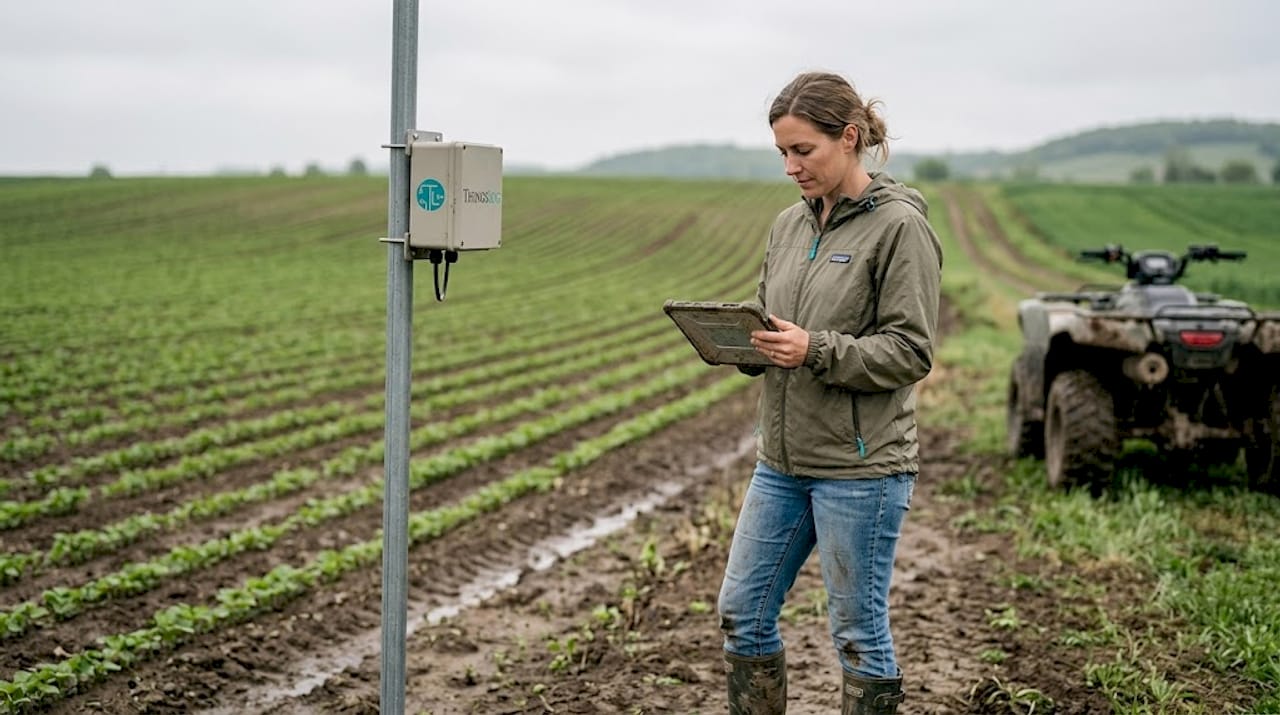
Precision agriculture depends on knowing what is happening in your fields and pastures continuously, not just during scheduled inspections. LoRaWAN supports this with sensors that monitor soil moisture, temperature, and gas concentrations across large areas on minimal power budgets. Published research demonstrates that LoRaWAN can monitor ammonia (NH3) emissions up to 1.94 ppm in livestock facilities, with soil moisture correlations of r=0.38 to 0.4, enabling farms to fine-tune irrigation and ventilation decisions with real data rather than estimates.
Key LoRaWAN agriculture sensor applications:
- Soil moisture and temperature at multiple depths for irrigation scheduling
- Ambient and soil temperature for frost event prediction
- Ammonia and CO2 monitoring in livestock housing for animal welfare compliance
- Weather station integration for micro-climate mapping
- Gate and water trough sensors for remote livestock welfare checks
For livestock operations specifically, a dedicated study found 97.5 percent packet success rate at ranges up to 6.5 km, with collar devices achieving 28-day battery life monitoring 15 cattle, and network scalability demonstrated to 200 animals with less than 3.5 percent packet loss. These are production-grade numbers for real farming environments.
| Application | Range Achieved | Battery Life | Packet Success |
|---|---|---|---|
| Soil moisture sensors | Up to 15 km (rural) | 2-5 years | 95%+ |
| Livestock collars | 6.5 km | 28 days | 97.5% |
| Ammonia monitors | 2-5 km (indoor) | 1-3 years | 90%+ |
Scalability is a real strength here. A single LoRaWAN gateway can serve hundreds of sensors across a large farm, making the cost per monitored point extremely competitive. You can explore how remote sensor deployments are structured for agricultural environments at different scales.
Pro Tip: Mix sensor modalities for robust monitoring. Combining soil moisture, temperature, and canopy sensors gives you much better irrigation decisions than any single data stream. The incremental cost of adding sensor types on an existing LoRaWAN network is minimal compared to the yield improvement potential.
Beyond basics: Advanced features, edge cases, and choosing LoRaWAN
After exploring real-world deployments, it is crucial to understand LoRaWAN’s advanced features, decision frameworks, and how it stacks up against alternative technologies.
LoRaWAN achieves its extraordinary range and battery life through Chirp Spread Spectrum (CSS) modulation and Adaptive Data Rate (ADR). ADR automatically adjusts transmission parameters based on signal conditions, balancing range against power consumption in real time. The technology supports thousands of devices per square kilometer, Class A end nodes with 10 to 15 year battery life, and deployment across private, public, and satellite-backed networks.
“Hybrid LoRaWAN networks that integrate satellite backhaul for rural gaps are increasingly the standard recommendation for national-scale utility deployments.”
Protocol selection checklist for IoT infrastructure managers:
- Define your data frequency requirement. Under one transmission per 15 minutes favors LoRaWAN.
- Assess your coverage geography. Rural and underground sites favor LoRaWAN with multi-gateway setups.
- Evaluate subscription cost tolerance. LoRaWAN on private networks eliminates recurring cellular fees.
- Check regulatory duty cycle limits. EU regulations cap LoRaWAN at 1 percent duty cycle per band.
- Confirm data payload size. LoRaWAN is optimal for small payloads. Video or large data requires cellular.
A detailed comparison of LoRaWAN vs NB-IoT shows that NB-IoT offers higher data rates and licensed-band reliability but carries recurring subscription costs and requires operator coverage. LoRaWAN wins on deployment flexibility and total cost of ownership for low-data remote monitoring.
| Criterion | LoRaWAN | NB-IoT |
|---|---|---|
| Spectrum | Unlicensed (free) | Licensed (subscription) |
| Network ownership | Private possible | Operator-dependent |
| Max payload | ~242 bytes | ~1600 bytes |
| Battery life | 10-15 years | 5-10 years |
| Best fit | Low-data, remote, private | Higher data, urban, mobile |
Pro Tip: Enable ADR in all deployments and review LoRaWAN best practices for your specific sector. ADR alone can extend battery life by 20 to 30 percent in networks where signal conditions vary by season or terrain.
What most IoT buyers miss about LoRaWAN deployments
We have reviewed impressive data from water utilities, energy facilities, and farms. But there is a harder truth worth stating: most LoRaWAN pilots that stall or fail do so because of assumptions made before the first gateway goes up, not because the technology does not work.
Overestimating universal indoor coverage is the most common error. Gateway range specifications are tested in open-air conditions. In dense urban areas or within reinforced concrete structures, effective range can drop by 60 to 70 percent. Battery life projections also assume predictable transmission intervals. When firmware bugs trigger rapid retransmissions, a 10-year device can drain in months.
Long-term maintenance is frequently underbudgeted. Firmware updates, gateway hardware refresh cycles, and network server migrations are real operational costs that often disappear from the business case. A single-stack LoRaWAN deployment with no fallback becomes a liability when the gateway goes offline in a remote location.
Our recommendation, drawn from deployments across utilities and agriculture, is to architect hybrid from the start. Pairing LoRaWAN with a backup NB-IoT path for critical nodes eliminates single points of failure. Before scaling, ask yourself: what is the plan when coverage has a gap, battery fails early, or you need to push a firmware update to 50,000 devices simultaneously? Reviewing IoT protocol selection insights before you finalize your architecture can save significant rework downstream.
Explore LoRaWAN-powered solutions with ThingsLog
If these use cases reflect operational challenges in your organization, the logical next step is working with a partner who has already solved the hard problems at scale.
ThingsLog’s remote IoT monitoring platform supports LoRaWAN natively across water utilities, energy facilities, and agricultural operations, combining configurable data loggers, environment sensors, and a cloud analytics platform into turnkey deployments. Whether you need LoRa smart water meters for NRW reduction or smart energy monitoring tools to cut consumption by 15 to 20 percent, ThingsLog can support pilots of any scale. Contact our team to discuss your deployment requirements and see how we configure solutions for your specific infrastructure context.
Frequently asked questions
What types of networks does LoRaWAN support for broad coverage?
LoRaWAN works over public, private, and satellite networks, with multi-gateway setups extending coverage to rural or underground environments where single-gateway reach is insufficient.
How long can LoRaWAN sensors operate before a battery change?
Many LoRaWAN devices function for 10 to 15 years on a single battery, and some specialized sensors extend this further using energy harvesting, such as water-powered boost converters that eliminate batteries entirely.
What are some limitations for LoRaWAN in dense deployments?
Duty cycle restrictions and data collisions can limit performance in high-density networks, but careful frequency planning and spreading factor assignment mitigates most collision risk.
How does LoRaWAN compare to NB-IoT for remote monitoring?
LoRaWAN is typically less expensive and well suited for low-data, remote applications, while NB-IoT offers higher throughput and licensed-band reliability for applications requiring more consistent connectivity or larger payloads.


