
TL;DR:
- IoT-enabled water monitoring reduces costs, detects leaks faster, and improves compliance accuracy.
- Proper assessment, sensor selection, and staff training are essential for successful implementation.
- Combining IoT data with behavioral initiatives maximizes water savings and operational resilience.
Manual water monitoring is costing facilities more than they realize. Undetected leaks, inaccurate meter reads, and delayed reporting create budget overruns and compliance gaps that compound over time. Water utilities face rising non-revenue water losses, while hospitality operators struggle to meet ESG targets without reliable consumption data. Hotels achieve measurable savings through IoT-enabled monitoring, but knowing where to start is half the challenge. This guide walks you through every stage, from assessing your facility’s needs and selecting the right tools, to implementing a system that delivers accurate, real-time water data and lasting operational improvements.
Table of Contents
- Assessing your water monitoring needs
- Essential IoT tools and setup requirements
- Step-by-step implementation guide
- Avoiding pitfalls and maximizing results
- The hidden ROI: why smart monitoring transforms more than your water bill
- Unlock smarter water usage with ThingsLog
- Frequently asked questions
Key Takeaways
| Point | Details |
|---|---|
| Define monitoring goals | Clarify your facility’s objectives and compliance needs before adopting IoT solutions. |
| Choose reliable IoT tools | Select robust sensors and hybrid networks for accurate, uninterrupted data collection. |
| Implement stepwise | Follow clear installation, calibration, and training steps for optimal performance and rapid ROI. |
| Sustain impact with people | Combine automated monitoring with staff and guest engagement for lasting water and cost savings. |
| Go beyond the bottom line | Smart water monitoring strengthens ESG compliance, audit readiness, and operational resilience. |
Assessing your water monitoring needs
Now that we understand the stakes and potential of IoT for water management, let’s clarify your facility’s specific needs. Jumping straight into hardware procurement without a clear monitoring strategy is one of the most common and costly mistakes we see. Baseline data and well-defined goals are the foundation of any effective water monitoring program.
Start by auditing your facility’s current water consumption patterns. Pull at least 12 months of billing data, identify peak usage periods, and flag any unexplained spikes. In hospitality, this might reveal that irrigation or laundry cycles are driving costs. In utilities, it often exposes distribution losses that manual meter reads simply cannot catch in time.
Next, map your monitoring points. Most facilities need coverage across:
- Main supply meters to track total intake
- Sub-meters for individual buildings, floors, or process lines
- Storage tanks and reservoirs for level and quality tracking
- Critical process points such as cooling towers, boilers, and irrigation systems
- Discharge and return lines for wastewater compliance
Regulatory and ESG reporting requirements add another layer of urgency. USALI 12 mandates water reporting including cost and volume data, and IoT platforms can automate this reporting in formats auditors and sustainability officers can use directly. For utilities, national water regulations increasingly require near-real-time reporting on distribution losses and quality parameters.
Finally, align your monitoring objectives with both your operations team and compliance team. These two groups often have different priorities, and a system designed only for one will underserve the other.
Pro Tip: Schedule a joint planning session with operations, finance, and compliance stakeholders before issuing any procurement request. Misaligned goals at this stage lead to expensive system redesigns later. You can explore real-time solutions to understand what data outputs each team actually needs.
Essential IoT tools and setup requirements
Once your monitoring objectives are clear, you’ll need the right IoT tools to capture water data accurately. The hardware and software stack you choose will determine both the quality of your data and the long-term reliability of your system.
Here is a practical overview of what a complete IoT water monitoring setup requires:
| Component | Purpose | Key consideration |
|---|---|---|
| Flow sensors | Measure water volume in pipes | Accuracy class, pipe diameter compatibility |
| Pressure sensors | Detect leaks and pressure anomalies | Range, IP rating for outdoor use |
| Level sensors | Monitor tank and reservoir levels | Ultrasonic vs. submersible options |
| Data loggers | Aggregate and transmit sensor data | Battery life, memory, connectivity options |
| IoT gateway | Route data to cloud platform | Protocol support, redundancy |
| Cloud analytics platform | Store, visualize, and alert on data | API access, reporting tools, scalability |
When evaluating specific devices, prioritize these features:
- Measurement accuracy rated to the precision your reporting requires
- Ingress protection (IP) ratings suitable for wet or outdoor environments
- Easy calibration procedures that field technicians can perform without specialist tools
- Remote access and configuration to reduce site visits
- Long battery life for remote or hard-to-access locations
Connectivity is often underestimated. LoRaWAN (Long Range Wide Area Network) works well for large campuses or distributed utility networks where power infrastructure is limited. NB-IoT (Narrowband IoT) suits urban deployments with strong cellular coverage. Hybrid networks combining both technologies provide the resilience that critical water infrastructure demands. Review the full range of supported sensors and devices to match hardware to your specific monitoring points.
For facilities with aging or legacy pipework, non-intrusive clamp-on sensors are a practical option. They attach externally to existing pipes without cutting or shutting down supply, which matters enormously in 24/7 hospitality operations.

Pro Tip: Consider LoRa smart meters for remote or low-power locations. Utilities using IoT monitoring reduce non-revenue water by 20-50%, and hotels typically achieve 25-40% water savings, making hardware investment decisions much easier to justify to finance teams.
Step-by-step implementation guide
With your equipment in hand, here’s how to turn your monitoring strategy into operational reality. A structured rollout reduces downtime, avoids data gaps, and gets your team confident with the new system faster.
- Site survey and sensor placement planning — Confirm exact installation locations, pipe diameters, access constraints, and power availability before ordering final hardware quantities.
- Device procurement and pre-configuration — Configure data loggers and gateways with correct transmission intervals, alert thresholds, and cloud platform credentials before deployment.
- Physical installation and commissioning — Install sensors, connect to gateways, and verify signal strength. Document each device’s location and ID for future maintenance.
- Data flow verification — Confirm that readings are arriving at the cloud platform at the expected intervals and that values align with known baseline figures.
- Alert and threshold setup — Define anomaly alerts for leak detection, pressure drops, and tank overflow conditions.
- Staff training and handover — Train operations staff on the dashboard, alert response procedures, and basic troubleshooting.
Manual vs. automated data collection: a direct comparison
| Factor | Manual collection | Automated IoT collection |
|---|---|---|
| Data frequency | Weekly or monthly | Every 15 minutes or less |
| Error rate | High (transcription errors) | Low (direct digital transmission) |
| Leak detection speed | Days to weeks | Minutes to hours |
| Reporting effort | High (manual compilation) | Low (automated exports) |
| Staff time required | Significant | Minimal after setup |
Staff engagement is not optional. Teams that understand what the data means and how to act on alerts are the difference between a monitoring system that sits unused and one that drives real savings. AI-powered analytics for water can surface insights automatically, but a human still needs to authorize the response.
Important: Sensor drift and fouling are real risks in water environments. Establish a maintenance schedule from day one, including quarterly calibration checks and annual sensor cleaning or replacement. Predictive maintenance approaches using AI and machine learning can flag anomalies before they become failures, with 96.7% accuracy documented in recent research.
Avoiding pitfalls and maximizing results
Successfully installed systems are only effective if maintained and paired with organizational engagement. Here’s how to optimize your results and avoid setbacks.
The most common technical issues we encounter after deployment are sensor fouling from sediment or biofilm buildup, calibration drift over time, intermittent connectivity in areas with weak signal, and power failures at remote sites. Each of these is manageable with the right protocols in place.
According to research on AI water monitoring, sensor fouling and connectivity loss are among the leading causes of data gaps and false alerts in IoT water systems. Mitigating these risks requires a combination of robust hardware selection and disciplined maintenance.
Your maintenance checklist should include:
- Monthly: Review alert logs for recurring anomalies; check connectivity status of all devices
- Quarterly: Calibrate flow and pressure sensors against a reference standard; inspect sensor housings for fouling or physical damage
- Annually: Replace batteries in low-power devices; conduct a full system audit against your original monitoring objectives
- After any major event: Verify sensor readings following pipe repairs, flooding, or significant operational changes
Explore advanced water quality monitoring to understand how quality parameters like turbidity and pH can be layered into your existing monitoring setup without a full system overhaul.
Pro Tip: Data alone does not change behavior. Facilities that combined IoT with guest and staff feedback achieved a 25.79% reduction in shower water volume. Pair your monitoring dashboard with a visible behavior-change program, such as real-time consumption displays in staff areas or guest-facing sustainability reports.
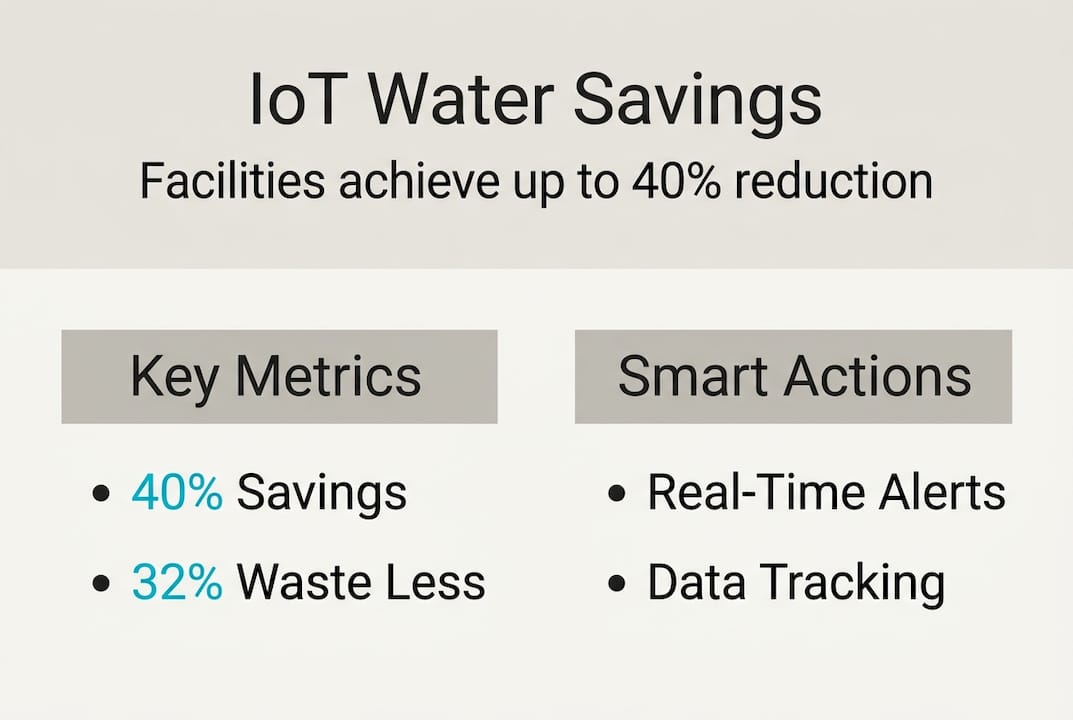
Statistic callout: Hotels that integrate IoT monitoring with operational programs have documented up to 32% reduction in water costs and 27% energy savings, making the business case for sustained investment clear.
The hidden ROI: why smart monitoring transforms more than your water bill
Yet the gains from smart water monitoring don’t stop at cost and consumption. We’ve worked with facilities that initially justified their IoT investment purely on leak detection savings, only to discover that the data was equally valuable for audit readiness, regulatory compliance, and guest experience.
Water data logged continuously and stored in a tamper-evident cloud platform becomes audit-ready evidence for ESG reporting, USALI compliance, and environmental certifications. Facilities that previously spent weeks compiling manual records for annual audits now export verified reports in minutes. That operational time saving has real financial value that rarely appears in the initial ROI calculation.
There’s also a resilience dimension that’s easy to overlook. Climate variability is increasing pressure on water supply reliability. Facilities with granular consumption data are better positioned to adapt quickly, whether that means identifying alternative sources, adjusting operational schedules, or demonstrating responsible usage to regulators. Monitoring water quality impacts in real time also protects guest health and brand reputation in ways that are genuinely difficult to quantify but impossible to ignore.
Our view is that smart water monitoring should be positioned internally not as a cost-reduction tool, but as a risk management and resilience investment. That framing opens different budget conversations and leads to more durable organizational commitment.
Unlock smarter water usage with ThingsLog
Ready to put your water data to work? Here’s how to get started with a solution designed for real-world results.
ThingsLog provides remote IoT monitoring solutions built specifically for water utilities and hospitality operators who need reliable, scalable, and audit-ready water data. Our platform integrates configurable data loggers, environment sensors, and cloud analytics into a single system that supports LoRa, NB-IoT, LTE-M, Wi-Fi, and Ethernet connectivity.
Whether you’re deploying across a single hotel property or managing a distributed utility network, our smart water metering solutions scale to match your operational complexity. From initial site assessment through to live dashboard configuration and staff training, we support every step of your implementation. Contact our team to discuss your facility’s specific monitoring objectives and get a tailored solution proposal.
Frequently asked questions
What is the most accurate way to monitor water usage?
Deploying IoT sensors with AI-powered analytics delivers up to 96.7% accuracy for real-time water usage and quality tracking, significantly outperforming manual meter reading methods.
How much water and cost savings can IoT monitoring deliver?
Utilities can reduce non-revenue water by 20-50% and hotels typically achieve 25-40% water savings with IoT solutions, with additional energy savings documented alongside water reductions.
What are common pitfalls of IoT water monitoring?
Sensor fouling, calibration drift, and connectivity loss are typical issues, but regular maintenance and hybrid protocols minimize these risks and keep data quality high.
Why combine IoT tech with staff and guest training?
Behavioral programs alongside IoT technology amplify savings significantly. Combining IoT with feedback reduced shower water usage by 25.79%, demonstrating that technology and human engagement together outperform either approach alone.


