Many water meters in the US carry an encoder register with a three-wire output. The register does not send pulses: it sends the meter reading itself. This guide explains what the three wires do, how a 3-wire water meter differs from a pulse meter and how to bring its reading online without replacing the meter.
3-wire in short
- 3-wire is a method for reading US water meters that have an encoder register
- The three wires are clock and power, data, and ground
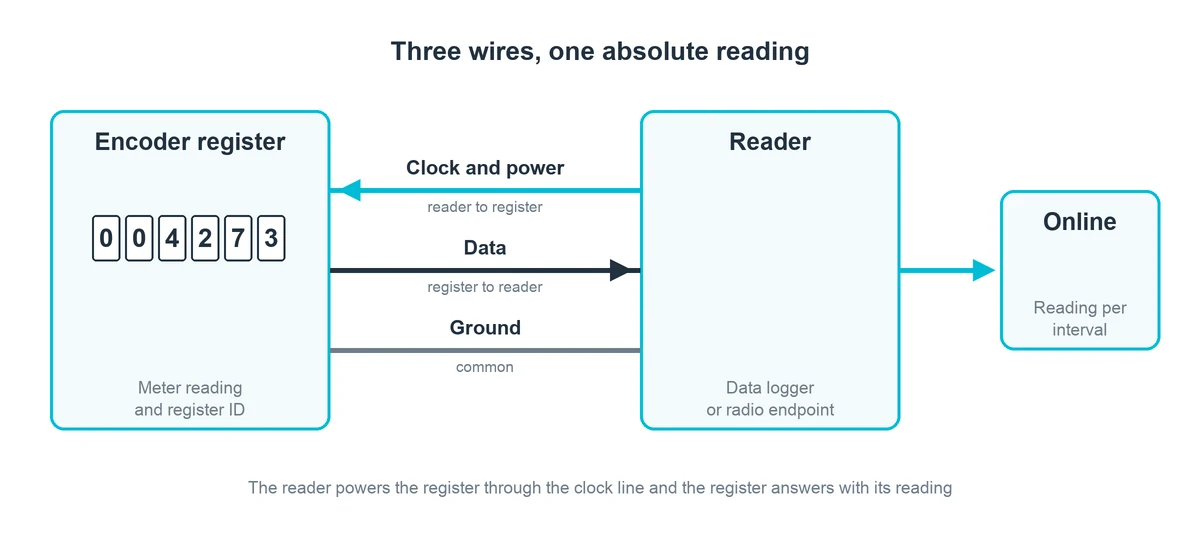
- The reader powers the register through the clock line for the moment of the reading
- The register answers with its absolute reading, the same number that the register shows, and its identification number
- No pulses are counted, so no pulse can be missed
How a 3-wire encoder register works
An encoder register knows its own reading. In a mechanical absolute encoder the position of every number wheel is sensed directly; in a solid-state register the reading is kept in non-volatile memory. In both cases the reading is there when somebody asks for it.
When a reader wants a reading, it applies a clock signal on the first wire. The same signal powers the register. The register sends back a short digital message on the data wire, with the meter reading and the register ID. The third wire is the common ground. After the message the reader removes the clock and the register rests until the next request.
The message format depends on the register, so the reader has to support the register model in use. This is the first thing to check before an installation.
3-wire, 2-wire and pulse outputs compared
| Output | Wires | What the reader receives | After a cable fault |
|---|---|---|---|
| 3-wire encoder | 3: clock and power, data, ground | The absolute reading and the register ID | The next reading is correct again |
| 2-wire encoder | 2, typically read through a touchpad | The absolute reading and the register ID | The next reading is correct again |
| Pulse: reed switch or open collector | 2 | One pulse per unit of volume, the reader keeps the count | Pulses during the fault are lost |
| KYZ, Form C pulse | 3: K, Y, Z | One pulse per changeover, the reader keeps the count | Pulses during the fault are lost |
A KYZ output also has three wires, but it is a pulse output and works in a different way. It has its own guide: KYZ pulses explained.
Where you find 3-wire registers
- Residential and commercial water meters that are read by AMR and AMI radio endpoints, also called MIUs
- Meters in pits and vaults, where the register cable runs to an endpoint under the lid
- Encoder registers of the main US meter makers, for example Neptune ProRead, ProCoder and E-CODER, Sensus encoder registers, Badger Meter HR-E and Master Meter AccuLinx
- Sub-meters in multi-family and commercial buildings
Wiring a 3-wire register
- Match the function, not the colour: wire colours differ between manufacturers, so follow the register documentation
- Keep the splices dry: use gel-filled connectors, because a meter pit floods sooner or later
- Check the cable length: the longest allowed run depends on the register and is given in its documentation
- Read once and compare: after wiring, take a reading and compare it with the reading shown on the register
What changes when the reading is online
A reader that interrogates the register at a fixed interval turns one manual reading per month into a consumption curve. Consumption per interval is the difference between two readings.
- Consumption per 15 minutes or per hour instead of one number per month
- Night flow that never falls to zero points to a leak, and you see it the next morning
- A burst shows as a step in the curve within hours, not on the next bill
- Readings for billing arrive without a visit to the pit
Reading 3-wire water meters with the ThingsLog LPMDL-210X
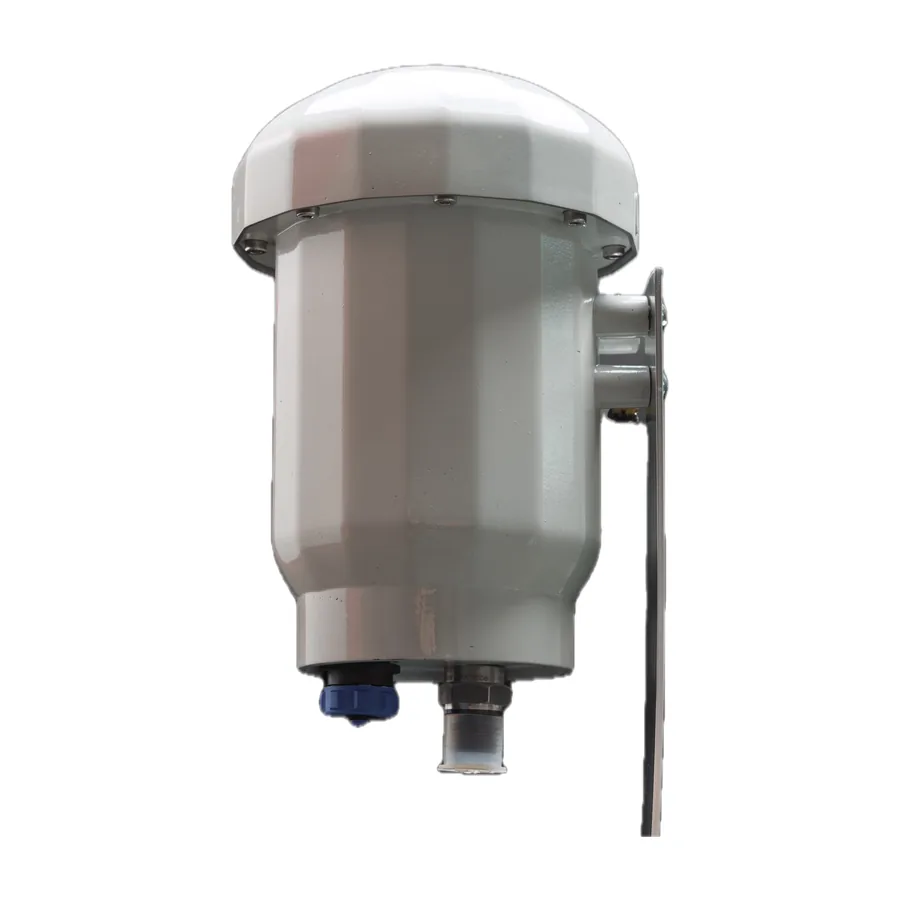
The ThingsLog LPMDL-210X data logger reads 3-wire US water meters, next to reed switch, open collector and KYZ pulses.
- The logger reads the meter reading from the encoder register
- Tell us the register model and we confirm the matching build
- IP68 enclosure and years on its own battery, with LTE-M, NB-IoT or 4G
- Built-in pressure sensors can report the pressure on the service line from the same device
- Consumption per interval and alarms in the ThingsLog platform and mobile app
A worked example is in our guide how to connect a 3-wire Neptune register.
Frequently asked questions
Is a 3-wire water meter a pulse meter?
No. A 3-wire encoder register sends its reading as a digital message when the reader asks for it. A pulse meter sends one pulse per unit of volume and leaves the counting to the reader. A three-wire pulse output does exist, the KYZ or Form C output, and it is described in KYZ pulses explained.
Does the register need a battery?
An absolute encoder register takes its power from the reader for the moment of the reading. The reader, for example a data logger or a radio endpoint, has its own battery.
Are the wire colours the same for all brands?
No. The colours differ between manufacturers. Wire by function and check the register documentation.
Can I get interval data from an encoder register?
Yes. The reader interrogates the register at the chosen interval and stores each reading. The difference between two readings is the consumption in that interval.